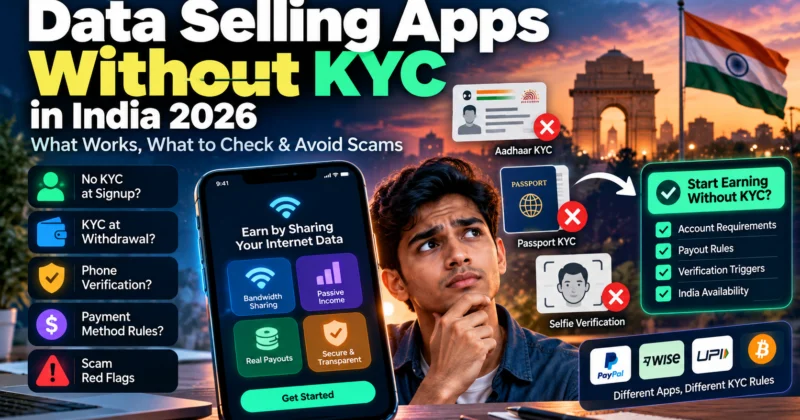
Data Selling Apps Without KYC in India 2026: What Works & What to Check
Looking for data selling apps without KYC? The important thing to understand is that “no KYC” can mean different things. An app may let you create an account without submitting a government ID, but still require phone verification, payment verification, or identity verification when you request a payout.
In other words, no KYC at signup does not necessarily mean no verification at withdrawal.
This guide explains how verification works with data-selling and bandwidth-sharing platforms, what to check before signing up, and how to identify misleading “100% no-KYC” earning claims.
Quick answer: Some data-selling and bandwidth-sharing platforms may allow you to start with basic account verification rather than government-ID KYC. However, payout providers or the platform itself can require additional verification later. Before using an app, check its current payout rules, verification policy, privacy policy, and India availability.
What Does “No KYC” Actually Mean?
When people search for data selling apps without KYC, they usually mean one of two things:
- They do not want to submit government identification just to start earning.
- They want to withdraw their earnings without going through an identity-verification process.
Those are not necessarily the same thing.
An earning platform can allow registration with an email address and password but later require phone verification or identity verification before processing a withdrawal.
Therefore, the phrase “no KYC” should always be qualified.
Different types of verification
| Verification type | Is it the same as KYC? | Why it may be requested |
|---|---|---|
| Email verification | No | Confirming account ownership |
| Phone verification | No | Security and fraud prevention |
| Payment verification | Not necessarily | Confirming the payout account or payment method |
| Government ID verification | Yes | Confirming identity |
| Selfie or identity check | Usually | Identity confirmation or fraud prevention |
| Tax information | Not necessarily | Payment or tax compliance |
This distinction is important because an article or video saying “no KYC required” may actually mean only that government ID is not requested during initial registration.
Do Data Selling Apps Require KYC?
There is no single rule that applies to every data-selling app.
Verification requirements depend on factors such as:
- the platform you use,
- your country or region,
- the payout method you choose,
- the payment provider involved,
- fraud or security checks, and
- the platform’s current terms and policies.
For example, Honeygain’s current Terms of Use state that users may need to validate their email and provide personal information or identity verification depending on the chosen payout method. It also says third-party payment providers can impose their own verification procedures. Honeygain’s current Terms of Use were updated in August 2026.
That means you should not interpret Honeygain as a guaranteed “no-KYC withdrawal” service simply because full identity verification may not be required at account creation.
Signup Verification vs Withdrawal Verification
This is the most important distinction in the entire topic.
1. Signup
A platform may only ask for basic information such as an email address and password when you create an account.
2. Earning
You may then be able to use the service and accumulate earnings without immediately submitting government identification.
3. Withdrawal
The situation can change when you request a payout.
The platform or its payment partner may require additional information before releasing the money.
Honeygain explicitly states that payout processing can require personal information or identity verification depending on the selected payout method. See the current Honeygain payout terms.
Pawns.app similarly states that payouts can require additional verification, including phone verification, and that identity verification may be required in certain circumstances such as specific payout requirements, suspicious activity, or legal obligations.
Therefore, always investigate the withdrawal stage—not just the signup screen.
Data Selling Apps Without KYC: What Current Platform Policies Say
Instead of publishing a static list of “10 guaranteed no-KYC apps,” it is more useful to examine what current platform documentation actually says.
Requirements can change, so the platform’s current terms and payout documentation should take priority over an old blog post, YouTube video, Telegram message, or referral page.
Honeygain
Honeygain is a bandwidth-sharing platform where users can earn by allowing the service to use part of their unused internet connection.
Its current Terms of Use state that the standard withdrawal threshold is $20, while payout processing can require email validation and certain personal information or identity verification depending on the chosen payout method.
Honeygain has also expanded its payout options in 2026, including additional gift-card options alongside existing payout routes. Honeygain’s August 2026 payout update explains the changes.
Important: Do not describe Honeygain as permanently “100% no KYC.” Its own terms allow verification requirements to apply depending on the payout method.
Pawns.app
Pawns.app is another platform that offers bandwidth sharing alongside other earning opportunities.
Its current privacy policy states that SMS verification is required for users who request a payout. It also says identity verification may be required in certain situations, including suspicious activity, specific payout requirements, or legal obligations.
Pawns.app’s help center also documents cases where a payout partner can request an ID check before processing a payout.
So Pawns.app should not be presented as a guaranteed no-KYC payout platform.
You can review the current Pawns.app Privacy Policy and its payout ID-check explanation before using the service.
PacketStream
PacketStream operates a bandwidth-sharing model through its Packeter software.
Its current Terms of Service state that users running Packeter must own the device and internet connection or be authorized to use them. PacketStream currently describes eligible Packeter traffic at $0.10 per GB, with a $5 minimum cashout, PayPal payouts, weekly processing, and a 3% cashout fee.
However, its terms do not give us a basis to promise that every user will be able to withdraw without any additional verification.
PacketStream also states that users are responsible for checking whether bandwidth sharing complies with their ISP’s terms, local law, and network-owner rules.
See the current PacketStream Terms of Service before signing up.
EarnApp
EarnApp is another bandwidth-sharing service with payout options that include services such as PayPal and Wise.
Its documentation shows that payment accounts may need to be verified before payment processing. For example, its auto-redeem documentation instructs users to verify their payment email, while its Wise payment documentation explains that an unverified Wise account can receive instructions from Wise to complete its own verification process.
This illustrates another important point:
The earning platform is not always the only party that determines verification requirements.
Is Phone Verification the Same as KYC?
No.
Phone verification normally confirms that you control a particular phone number. It is different from a government identity check.
For example, Pawns.app’s current policy states that SMS verification is required for payouts. It separately describes identity verification as a different process that may be required in certain circumstances.
This means an article saying:
“This app requires verification, so it is not a no-KYC app.”
may be technically misleading if the only requirement is an SMS code.
When evaluating an app, always identify what type of verification is actually being requested.
Can You Earn Money Without Submitting Government ID?
Sometimes, potentially.
But there is a major difference between these two statements:
Statement A: “I can create an account without uploading government ID.”
Statement B: “I can earn and withdraw money without ever providing identity verification.”
Statement B requires much stronger evidence.
A platform may let you start earning with basic account verification and then introduce an identity check during payout. Payment providers can also have their own requirements.
Therefore, if a website promises “never any KYC, guaranteed”, look for the actual terms supporting that claim.
Why Can KYC or ID Verification Appear at Withdrawal?
There are several possible reasons.
Payment provider requirements
The platform may use a third-party payment service. That provider can have its own verification procedures.
Fraud prevention
Platforms may use additional checks to prevent account abuse, duplicate accounts, fraudulent activity, or manipulated payouts.
Legal or compliance requirements
A platform may need additional information in specific circumstances to meet applicable legal or compliance obligations.
Country-specific requirements
Payout methods can differ between countries. A payment method available to one user may not be available to another, and its verification process can also differ.
For this reason, never assume that a verification experience shown by an Indian YouTuber or another user will be identical to yours.
What About Data Selling Apps in India?
For Indian users, there are several additional things worth checking before providing personal information.
- Is the platform available in India?
- Does it support a payout method you can actually use?
- Does the payment provider operate in your region?
- Does the platform clearly explain what information it collects?
- Does the privacy policy explain why that information is processed?
- Does the platform explain its withdrawal and verification requirements?
India’s Digital Personal Data Protection Act, 2023 establishes a framework concerning the processing of digital personal data. The government also notified the Digital Personal Data Protection Rules, 2025.
The implementation timeline for different provisions is not identical, so you should not interpret the existence of the Act or Rules as meaning that every data-selling platform automatically has the same KYC obligation.
The practical lesson is simpler: understand what information an app is asking for, why it is asking for it, and what happens to that information.
How to Check Whether a “No KYC” Claim Is Real
Use this checklist before installing an unfamiliar app.
Step 1: Visit the official website
Do not rely only on an affiliate landing page or referral link.
Step 2: Find the Terms of Service
Search the terms for words such as:
- KYC
- identity verification
- verification
- withdrawal
- payout
- payment provider
Step 3: Check the payout page
Do not stop at the signup requirements. Look specifically for what happens when you request your first withdrawal.
Step 4: Check the payment provider
If the platform pays through PayPal, Wise, crypto, gift cards, or another third party, check whether that payment method has separate account requirements.
Step 5: Check India availability
Some payment methods and earning opportunities vary by country or region.
Step 6: Check the privacy policy
Look at what information the company collects and why it says that information is needed.
Step 7: Check the date
A 2024 or 2025 video can be outdated even if the platform itself is still operating in 2026.
10 Red Flags in “No KYC” Earning Apps
Be particularly careful when a platform combines “no KYC” with unrealistic income promises.
- “100% anonymous forever” without explaining the payout process.
- Guaranteed daily income with no explanation of traffic, demand, or earning conditions.
- Large upfront registration fees.
- Security deposits required before you can withdraw.
- Requests for your UPI PIN.
- Requests for your ATM PIN or banking password.
- Requests for OTPs unrelated to the platform’s own login process.
- No identifiable company or support channel.
- No accessible privacy policy or terms.
- Pressure to deposit money before withdrawing your earnings.
A legitimate platform can still have verification requirements. The absence of KYC is not proof that an app is legitimate.
What You Should Never Give a Data-Selling App
Whether an app claims to require KYC or not, certain credentials should never be handed over casually.
- UPI PIN
- ATM PIN
- Internet banking password
- Email password
- Crypto seed phrase
- Crypto recovery codes
- Two-factor authentication recovery codes
- Remote desktop credentials
- Unrelated OTPs
Legitimate identity verification and banking credentials are completely different things.
An identity-verification provider may legitimately request identification documents during an established verification process. That does not mean you should give an earning app your banking password, UPI PIN, or recovery credentials.
“No KYC” vs “Low Verification”
A more useful way to evaluate these platforms is to classify the actual requirement.
| What you see | What it actually means |
|---|---|
| No government ID at signup | Basic registration may be possible without identity documents |
| Email verification | Account ownership confirmation |
| Phone verification | Security or anti-abuse verification |
| Payment email/account verification | Confirmation of the payout destination |
| ID requested at withdrawal | Identity verification may be required for the payout |
| Verification only in certain cases | Additional checks may be triggered by specific circumstances |
This is why “no KYC at signup” is a much safer and more precise statement than “no KYC ever.”
Can You Avoid KYC by Choosing a Different Payout Method?
Do not treat a different payout method as a guaranteed way to avoid legitimate verification.
Some platforms explicitly state that requirements can vary according to the payout method. Honeygain’s current terms are one example: the company says personal information or identity verification may be required depending on the chosen payout method.
A different payment option may therefore have different requirements, but that does not mean you should select a payment method specifically to circumvent a legitimate verification requirement.
Instead, compare the available payout methods and understand their requirements before you start earning.
Does No KYC Mean the App Is Safer?
No.
KYC status and overall platform safety are separate questions.
An app can require no government ID but still have poor privacy practices.
Another platform can require identity verification while providing detailed policies, established payout procedures, and clear explanations of how personal information is handled.
When evaluating a data-selling app, look at the complete picture:
- What data does the app collect?
- What permissions does it request?
- Why does it need those permissions?
- How does bandwidth sharing work?
- Who receives or processes your information?
- What are the payout rules?
- What verification can happen at withdrawal?
- Can you stop sharing your connection?
- Is there a clear privacy policy?
- Are the terms and payout conditions transparent?
For a deeper look at the privacy and network risks involved, read our guide: Are Data Selling Apps Safe? Privacy Risks, Bandwidth Sharing & Scam Checklist.
5-Minute Verification Checklist Before You Sign Up
Before installing a data-selling app, check these seven things:
- Official website exists.
- Terms of Service are accessible.
- Privacy Policy is accessible.
- Withdrawal requirements are documented.
- Payment methods are clearly explained.
- Verification requirements are disclosed.
- There is no requirement to pay money just to unlock your earnings.
If you cannot answer these questions, do not assume that an app is safe simply because a social-media post says “no KYC.”
How This Connects With Data Selling Apps That Pay in Indian Rupees
If your main concern is not KYC but receiving your earnings in India, the payout method becomes equally important.
Read our guide to data selling apps that pay in Indian rupees to understand the payout side separately.
You can also read our practical guide on how to earn money from data-selling apps.
For the broader explanation of the business model, see how data-selling apps work.
And if you want a broader comparison of platforms, start with our main guide to data selling apps in India.
Frequently Asked Questions
Do data selling apps require KYC?
Not always at signup. However, some platforms or their payment providers can require additional verification during withdrawal or in specific circumstances. Requirements vary by platform and payout method.
Which data selling apps work without KYC?
It is better not to treat “no KYC” as a permanent platform characteristic. Some services may allow initial registration without government-ID verification, but their payout terms can still allow phone, payment, or identity verification later.
Can I sell internet data without KYC?
Some bandwidth-sharing services may allow you to start sharing bandwidth without immediately submitting government identification. However, you should check the current payout and verification requirements before assuming you can withdraw without ID.
Is phone verification the same as KYC?
No. Phone verification normally confirms control of a phone number. KYC or identity verification generally refers to a process used to establish a person’s identity, often using official identification or another identity-verification method.
Can an app ask for KYC when I withdraw?
Yes. A platform or its payment provider can have verification requirements that apply during payout. Pawns.app, for example, documents situations where a payout partner can request an ID check before processing a payout.
Can payment providers require verification?
Yes. The earning platform may use a third-party payment provider, and that provider can have its own verification procedures or account requirements.
Should I avoid every app that asks for ID?
No. An identity check by itself does not prove that an app is unsafe. The important questions are who is requesting the information, why it is needed, how the process is performed, and whether the requirement is clearly documented.
Can KYC requirements change after I register?
Yes. Platform terms, payout providers, available payment methods, and compliance procedures can change. Always check the current documentation before making a withdrawal.
Are no-KYC data selling apps safe?
No-KYC status alone cannot establish safety. You should separately evaluate privacy practices, permissions, bandwidth-sharing behavior, payout rules, company transparency, and scam indicators.
Can I withdraw without submitting Aadhaar?
That depends on the platform and payment route. Do not assume that Aadhaar is always required or always unnecessary. Check the current identity and payout requirements for the specific service and payment method you intend to use.
Final Takeaway
“No KYC at signup” does not necessarily mean “no verification ever.”
For data-selling and bandwidth-sharing apps, verification can exist at several levels: email confirmation, phone verification, payment-account verification, or full identity verification.
The most important step is therefore not finding an app that makes the loudest “NO KYC” claim. It is checking the actual payout rules, verification requirements, privacy policy, payment provider and India availability before you start.
If an app promises huge earnings, demands money before withdrawal, asks for sensitive banking credentials, or cannot clearly explain its verification and payout process, treat that as a warning sign.
Next: Before sharing your internet connection with any platform, learn about the privacy, IP-address, bandwidth and scam risks in our detailed guide:
Are Data Selling Apps Safe? Privacy Risks, Bandwidth Sharing & Scam Checklist →