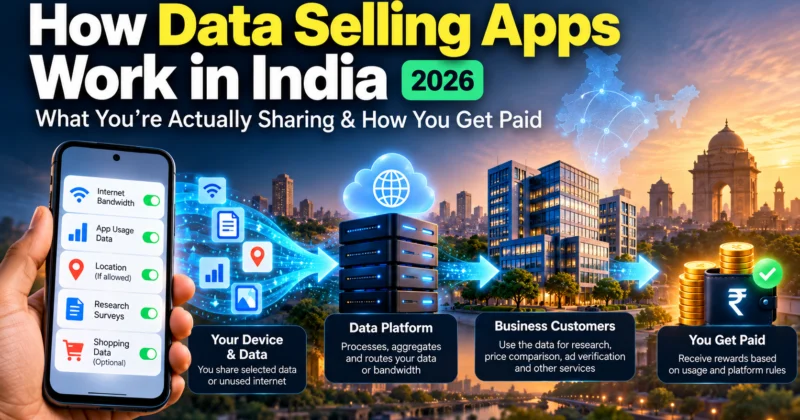
Quick answer: “Data selling” is not one single business model. Some platforms reward you for sharing unused internet bandwidth, while others may compensate you for survey responses, consumer research, usage information, or other permitted data. The exact information collected, how it is used, and how you are paid depends on the platform.
If you’ve searched for “how data selling apps work”, you’ve probably seen a lot of confusing explanations.
Some websites make it sound like you can simply sell your private information for easy money. Others call every bandwidth-sharing service a “personal data selling app.”
Neither explanation is precise enough.
The reality is that several different models are grouped under the phrase “data selling.”
In this guide, we’ll break down what actually happens between your device, the platform and its business customers — what you may be sharing, where the money comes from, how earnings are calculated, and what you should check before installing an app.
What Are Data Selling Apps?
A data-selling app is a platform that allows users to receive rewards in exchange for contributing some form of data, information, research input, or internet-resource capacity.
But the word data can mean very different things.
For example:
- A survey platform may pay for your opinions.
- A research panel may collect permitted usage information.
- A receipt-rewards service may collect purchase information.
- A bandwidth-sharing platform may pay you for traffic routed through your internet connection.
These are economically different models.
The most important distinction:
Sharing internet bandwidth is not automatically the same thing as selling your personal information.
For example, bandwidth-sharing services can operate by routing business traffic through participating users’ internet connections rather than accessing their personal files or messages.
That’s why you should always ask:
“What exactly am I providing to this platform?”
before asking:
“How much can I earn?”
The 4 Common Data-Monetization Models
| Model | What You Provide | Typical Reward |
|---|---|---|
| Bandwidth sharing | Unused internet connection capacity | Cash or credits |
| Research panels | Permitted usage or consumer information | Points, cash or gifts |
| Surveys | Opinions and answers | Cash or points |
| Purchase/receipt data | Shopping or receipt information | Points or cash |
Not every platform fits neatly into one category, and some combine multiple models.
For DailySimplify, we use “data selling” as a broad search term, but the actual mechanism matters more than the label.
How Data Selling Apps Actually Make Money
This is the part most beginner articles skip.
If an app pays you, where does its money come from?
The basic business model looks like this:
You
↓
Provide permitted data, research input or unused bandwidth
↓
Data Platform
↓
Processes, aggregates, routes or organizes that resource
↓
Business Customer
↓
Pays for the service or network access
↓
Platform
↓
Shares a portion of its revenue according to its reward system
↓
You Get Paid
The platform isn’t normally paying users out of nowhere.
It is operating a business that sells some form of service to another customer.
How Bandwidth-Sharing Apps Work
Bandwidth-sharing is one of the most misunderstood parts of the “sell your data” industry.
Your internet connection has a certain capacity.
For example, imagine you have a 100 Mbps broadband connection.
That doesn’t mean you constantly use 100 Mbps.
When you’re not downloading, streaming or otherwise consuming that capacity, some of the connection may remain unused.
A bandwidth-sharing application can use a portion of that capacity while it is running.
Bandwidth-sharing services can allow business customers to use participating residential connections for activities such as public-web data collection, market research, price comparison and ad verification.
The Simplified Flow
Your Device
↓
Internet Connection
↓
Bandwidth-Sharing Application
↓
Platform Network
↓
Business Customer Request
↓
Eligible Traffic Is Routed
↓
Platform Records Eligible Usage
↓
User Receives Reward
That’s fundamentally different from:
“The app downloads all your private files and sells them.”
The exact technical and privacy behavior still depends on the individual platform, so its privacy policy and terms matter.
What Are You Actually Sharing?
This is where you need to stop treating every data-selling app as identical.
1. Internet Bandwidth
With a bandwidth-sharing service, the resource being monetized is primarily your internet connection capacity.
You are not necessarily giving the platform your:
- WhatsApp messages
- Photographs
- Passwords
- Documents
- Banking credentials
But you are still allowing a third-party network to use your connection.
That means you should check:
- Acceptable-use rules
- Privacy policy
- Traffic limitations
- ISP or mobile-plan restrictions
- Device compatibility
- Whether your connection has a data cap
2. Survey Responses
A survey platform works differently.
You might provide information such as:
- Product preferences
- Opinions
- Demographic information
- Purchasing habits
- Answers to market-research questions
The platform can then provide aggregated research information to customers.
Here, the thing being monetized isn’t your unused internet connection.
It is your research input.
3. Usage or Behavioral Information
Some research programs can collect information about how devices or services are used.
Depending on the specific platform, this could involve things such as:
- Application usage
- Browsing-related information
- Device information
- Consumer behavior
- Purchasing patterns
But don’t assume that one platform’s collection practices apply to another.
Always verify what the individual app collects.
What Is the Difference Between Bandwidth and Mobile Data?
This is one of the biggest misconceptions.
Suppose your mobile plan gives you:
2 GB of data per day.
That does not automatically mean:
“I can sell those 2 GB for ₹X.”
Your mobile plan is an allowance for internet consumption.
Bandwidth-sharing is about allowing a service to route eligible traffic through your connection.
Those are related concepts, but they are not identical.
Think of It This Way
Your mobile plan gives you access to a road.
Bandwidth is the road’s capacity.
Traffic is what actually travels over it.
A bandwidth-sharing service may pay according to the traffic that actually passes through its network under its rules.
So:
How Does a Data-Selling App Know How Much to Pay You?
There isn’t one universal formula.
Different platforms use different reward systems.
Common factors include:
- Location
- Network demand
- Connection speed
- Connection stability
- Actual traffic routed
- Time actively used
- Platform-specific limits
- Payout rules
Some platforms calculate rewards based on traffic, while others use time-based or activity-based systems.
Therefore, don’t calculate your income simply as:
“My internet plan has 100 GB, so I will earn 100 × the advertised rate.”
The platform needs actual eligible demand and traffic.
Example: Why Earnings Can Be Different for Two Users
Imagine two people install the same bandwidth-sharing application.
User A
- Stable broadband
- High demand in their location
- App runs regularly
- Traffic is actually routed
User B
- Limited mobile connection
- Low demand in their location
- Device is frequently offline
- Little traffic is requested
They can have completely different earnings.
That’s why screenshots showing one person’s income should not be treated as a guaranteed earning rate for everyone.
How Do You Actually Get Paid?
The typical process looks like this:
- Create an account.
- Install the application.
- Grant the permissions required for its specific function.
- Keep the service active.
- Generate eligible activity or traffic.
- Accumulate rewards.
- Reach the payout threshold.
- Request withdrawal.
- Receive the payment through the supported method.
The payout method varies considerably.
Some platforms support PayPal, cryptocurrency, gift cards or other payment methods depending on the country and current program rules.
Do not assume an app supports UPI just because it says “cash.”
Check the actual withdrawal methods before investing your time or bandwidth.
Why Would Companies Pay for Your Internet Connection?
This is the business question behind bandwidth sharing.
A company may need access to the web from different geographic locations.
Check Prices
A company can compare how products or prices appear from different locations.
Verify Advertising
Businesses can check whether advertisements are actually being displayed correctly.
Collect Public-Web Information
Research companies can gather information that is publicly available on websites.
Conduct Market Research
Businesses can study markets and online behavior.
This is the economic reason a residential connection can have value.
Can Data-Selling Apps See Your Browsing History?
There is no universal answer.
This depends on the application.
A bandwidth-sharing application and a behavioral research application can have completely different technical architectures.
Some bandwidth-sharing services explicitly state that they do not access users’ personal browsing history, but you should never take one company’s privacy model and apply it to every data-selling platform.
Before installing an app, check:
- What information does it collect?
- Why does it collect it?
- Is collection necessary for the service?
- Does it share information with third parties?
- How long is information retained?
- Can you withdraw consent?
- Can you delete your account?
- What permissions does the app request?
What Permissions Should You Be Careful About?
A simple rule is:
The permission should make sense for the feature you’re using.
| Permission | What to Consider |
|---|---|
| Internet/network access | Expected for bandwidth-related services |
| Notifications | Usually related to alerts |
| Location | Ask why location is necessary |
| Usage access | Understand exactly what is measured |
| Camera | Reasonable for receipt scanning, not automatically for earning |
| Contacts | Usually unrelated to basic bandwidth sharing |
| SMS | Strong reason required |
| Call logs | Strong reason required |
| Accessibility access | Powerful permission; scrutinize carefully |
A legitimate application can still request permissions.
The question is not simply:
“Does it ask for permission?”
The better question is:
“Does the permission match what the application actually needs to do?”
Red Flags: When a Data-Selling App Deserves Extra Scrutiny
1. Guarantees a Fixed Daily Income
Claims like:
“Earn ₹5,000 every day automatically.”
should immediately make you skeptical.
Legitimate bandwidth-sharing earnings depend on factors such as demand and actual usage.
2. Requires an Activation Fee
Be cautious about applications that demand a mysterious “activation charge” just to unlock supposed earnings.
3. Has No Clear Privacy Policy
If you can’t determine what information is collected, that’s a serious problem.
4. Requests Unrelated Permissions
An application designed to share bandwidth shouldn’t need unrestricted access to your contacts and SMS without a clear explanation.
5. Promises Instant Withdrawals Without Explaining Thresholds
Look for:
- Minimum payout
- Processing time
- Supported payment methods
- Fees
- Account restrictions
6. Only Provides an APK From an Unknown Website
Use the official distribution channel where possible and verify that you’re installing the genuine application.
Is Data Selling Legal in India?
This needs more nuance than the simple claims you’ll find on many earning websites.
India has the Digital Personal Data Protection Act, 2023, but you should not interpret the existence of consent as an automatic guarantee that every data-selling platform is legally compliant.
Whether a particular service meets its legal obligations depends on what it collects, why it processes it, how it handles the information, what notices and consent mechanisms it provides, and the obligations applicable to that processing.
So don’t use this rule:
“The app asks for consent, therefore everything it does is legally compliant.”
Instead use:
Understand the data being collected, the stated purpose, the permissions involved and the platform’s privacy documentation.
For a deeper look at privacy and scam risks, read our data-selling safety guide.
How Much Can You Realistically Earn?
This is where expectations need to stay realistic.
There is no universal monthly income for data-selling apps.
For bandwidth-sharing services, earnings can depend on:
Location × Demand × Connection × Actual Usage × Platform Rate
Published maximums or promotional examples should not be treated as guaranteed income.
Different platforms can also use completely different reward systems.
Important: Data selling should generally be viewed as a supplementary-income model, not a replacement for a salary or skilled online business.
Data Selling vs Other Online Earning Methods
| Method | Active Work | Income Potential | Main Resource |
|---|---|---|---|
| Bandwidth sharing | Very low | Low | Internet connection |
| Surveys | Low | Low | Time + opinions |
| Freelancing | High | High | Skill + time |
| Affiliate marketing | Medium | Medium–high | Audience/traffic |
| Digital products | Medium | Medium–high | Knowledge/product |
| Content creation | High initially | Variable | Content + audience |
The advantage of bandwidth sharing is low effort.
The disadvantage is that low effort generally comes with limited earnings.
That’s the trade-off.
Is It Worth Using a Data-Selling App?
There isn’t one answer for everyone.
It May Make Sense If:
- You already have a stable connection.
- Your plan permits the activity.
- You understand the platform’s model.
- Your bandwidth isn’t expensive.
- The payout method works for you.
- You’re comfortable with the privacy and network implications.
- You view the income as supplementary.
It May Not Make Sense If:
- Your mobile data is expensive.
- Your connection has a strict data cap.
- The platform consumes more resources than you’re comfortable with.
- The payout threshold is difficult to reach.
- The privacy policy is unclear.
- The company makes unrealistic earning claims.
The right question isn’t:
“Can this app make me rich?”
It’s:
“Is the amount I receive worth the resource and privacy trade-off?”
How to Start Safely
Before installing your first data-selling app, use this checklist.
Step 1 — Understand the Model
Determine whether you’re sharing:
- Bandwidth
- Survey responses
- Usage information
- Purchase information
- Something else
Step 2 — Read the Privacy Policy
Look specifically for:
- Information collected
- Purpose
- Third parties
- Retention
- Deletion
- Consent
Step 3 — Check Your Internet Plan
Especially if you’re using mobile data.
Step 4 — Check Payout Rules
Find:
- Minimum withdrawal
- Payment method
- Fees
- Processing time
- Country availability
Step 5 — Start With One Platform
Don’t install five applications simultaneously before understanding how the first one works.
Step 6 — Track Your Actual Results
After several weeks, calculate:
That’s more useful than an advertised maximum.
Want to Compare Actual Data-Selling Apps?
If you’re at the research stage and want to compare specific platforms, start with our main guide:
Best Data Selling Apps in India 2026: How They Work, Earnings & Safety
It focuses on the platform comparison rather than explaining the underlying business model.
If your main question is specifically about getting paid in Indian currency:
Data Selling Apps That Pay in Indian Rupees 2026
And if you want the practical setup process:
How to Earn Money From a Data Selling App in India
Frequently Asked Questions
What are data-selling apps?
Data-selling apps are platforms that reward users for contributing some form of monetizable data, research information, or internet-resource capacity. The exact model differs by platform.
Do data-selling apps sell my personal information?
Not necessarily. Some platforms monetize bandwidth rather than personal information. Others may collect research or behavioral information. You need to check each platform’s privacy policy.
How do bandwidth-sharing apps work?
They allow a platform to route eligible traffic through your internet connection while the application is running. The platform then credits you according to its own reward model.
Does selling internet data mean selling my 2 GB or 5 GB mobile plan?
No. Your mobile-data allowance is not automatically an asset you can sell at a fixed rate. Bandwidth-sharing platforms generally reward eligible traffic or activity actually used by their network.
How much can I earn from data-selling apps?
It varies significantly. Location, demand, connection, actual usage and the platform’s payment model can all affect earnings. Published maximums should not be treated as guaranteed income.
Do data-selling apps work in India?
Some international bandwidth-sharing services are available in India, but availability, demand and payout options can vary. Always verify the current terms and payment methods before signing up.
Can I use multiple devices?
Some platforms allow multiple devices, but their rules differ. Never assume that running multiple devices or connections is permitted simply because technically it is possible.
Is data selling a good way to earn ₹1,000 per day?
Generally, you should not treat bandwidth-sharing as a reliable ₹1,000-per-day income method. Its primary attraction is low effort, while earnings are usually constrained by demand and the amount of eligible activity.
If your target is ₹1,000/day, compare it with higher-effort methods such as freelancing, digital products or other skill-based online work. You can see broader options in our guide to earning ₹1,000 daily online without investment.
Final Takeaway
Data selling isn’t one single thing.
That’s the most important point to understand.
Some platforms monetize unused internet bandwidth. Others compensate users for research responses, consumer information or other permitted data.
The business model is relatively simple:
But your earning potential depends on the actual model.
Before installing anything, determine:
- What exactly am I sharing?
- Why does the platform need it?
- Who is using it?
- How is my reward calculated?
- What is the minimum payout?
- What fees apply?
- What permissions does the app require?
- What happens to my data or connection when I stop using it?
Once you understand those eight questions, “data selling” stops sounding like mysterious passive income and starts looking like what it actually is: a collection of different internet-based monetization models, each with its own economics and trade-offs.