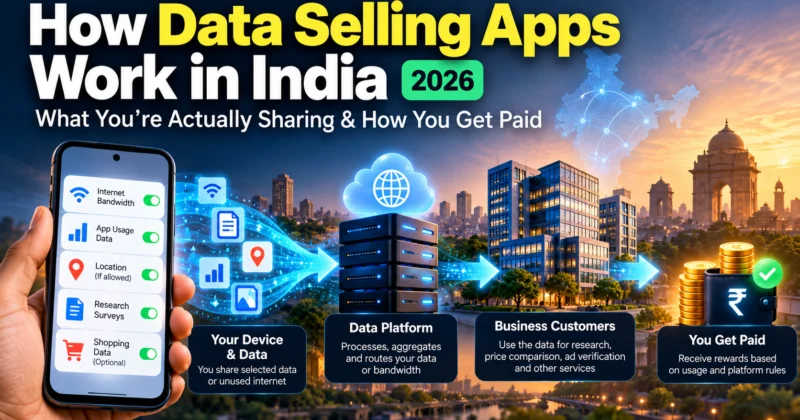
Quick answer: Data-selling apps are not automatically safe or unsafe. The risk depends on what the app collects, what permissions it receives, how your data or internet connection is used, who receives it, and how transparent the company is about those practices.
There is also an important distinction that many articles miss: sharing unused internet bandwidth is not the same thing as selling your personal information.
Some platforms operate bandwidth-sharing networks, while others may collect survey responses, consumer information, usage information, purchase data, or other forms of research data.
Before installing any data-selling or bandwidth-sharing app, you should be able to answer seven basic questions:
- What exactly am I sharing?
- Why does the platform need it?
- What permissions does the app require?
- Who receives the data or network traffic?
- What does the privacy policy say?
- How do payouts and withdrawals work?
- Can I stop sharing whenever I want?
Bottom line: If you cannot clearly understand what an app is collecting or what your internet connection will be used for, don’t install it yet.
What Does “Safe” Mean for a Data-Selling App?
When people ask “Are data selling apps safe?”, they are usually talking about several different risks at once.
For this reason, safety should be evaluated across multiple areas rather than reduced to a simple “safe” or “unsafe” label.
1. Privacy Safety
What personal information does the company collect?
Does it collect only information required to operate the service, or does it collect additional information for analytics, advertising or other purposes?
2. Device Safety
What permissions does the application request?
An application that requests access to contacts, SMS, files or accessibility controls deserves more scrutiny than an application that only needs the permissions required for its stated function.
3. Network Safety
If the service involves bandwidth sharing, what type of traffic is routed through your connection?
What does the provider say about acceptable traffic, network abuse and your public IP address?
4. Financial Safety
Can you actually withdraw your earnings?
Check the minimum payout, supported payment methods, fees, processing time and account restrictions.
5. Transparency
Can you identify the company behind the service?
Does it publish understandable privacy policies and terms of service?
These five areas give you a much better way to evaluate an app than simply searching for a “safe data-selling app” list.
Are Bandwidth-Sharing Apps the Same as Data-Selling Apps?
No.
The phrase “data selling” is often used broadly, but different platforms can monetize completely different resources.
| Model | What You Provide | Main Risk to Examine |
|---|---|---|
| Bandwidth sharing | Internet connection capacity | Network use, IP exposure and ISP rules |
| Surveys | Opinions and answers | Information disclosure |
| Research panels | Usage or consumer information | Privacy and profiling |
| Receipt/purchase platforms | Shopping information | Consumer and purchase data |
| Behavioral-data services | Usage or activity information | Privacy and data sharing |
For example, Honeygain describes its core service as sharing unused internet bandwidth rather than personal files or browsing history. At the same time, its published privacy policy identifies account, device, IP, location and network information that it processes. :contentReference[oaicite:0]{index=0}
That distinction is important:
does not necessarily mean
“The service collects absolutely no personal information.”
You need to examine the actual privacy policy of the platform you are considering.
If you want to understand the underlying models before evaluating their safety, read our guide on how data selling apps work.
What Are the Real Risks of Data-Selling Apps?
There isn’t one universal risk. Different business models create different types of exposure.
Privacy Risk
A platform may process information such as:
- Email or account information
- IP address
- Device information
- Operating-system information
- Approximate location
- Network information
- Usage analytics
- Payout information
The exact categories depend on the service.
For example, Honeygain’s published privacy policy lists account information, payout-related information, IP address, operating-system version, device model, last-seen timestamp, location and network information among the data it processes. :contentReference[oaicite:1]{index=1}
This is why the privacy policy matters more than a marketing statement such as “we don’t sell your personal data.”
Network Risk
Bandwidth-sharing services introduce a different type of consideration.
Your connection may become part of a network through which customer traffic is routed.
PacketStream describes its bandwidth-sharing system as a peer-to-peer proxy network in which participating connections can act as exit points for traffic assigned by the network. A destination can therefore see the public IP address of the participating connection. :contentReference[oaicite:2]{index=2}
This doesn’t mean that your personal files or browsing history are automatically exposed.
It does mean you should understand the role your connection is playing.
Device Risk
Every application adds some amount of software exposure.
Pay particular attention to:
- Where the application came from
- Whether it receives regular updates
- What permissions it requests
- Whether it runs continuously in the background
- Whether it consumes significant CPU, memory or battery
- Whether the application has a clear operator and support channel
Financial Risk
Even if an application is legitimate, the earning model may not be attractive for you.
Check:
- Minimum withdrawal
- Payment method
- Withdrawal fees
- Processing time
- Country availability
- Account restrictions
For example, PacketStream’s current terms state that Packeter users are credited at $0.10 per GB of eligible customer traffic, with a $5 minimum cashout, PayPal payment and a 3% cashout fee. Its terms also require users to confirm that bandwidth sharing complies with their ISP terms and applicable rules. :contentReference[oaicite:3]{index=3}
Trust and Transparency Risk
A platform becomes much harder to evaluate when you cannot determine:
- Who operates it
- What its business model is
- What data it collects
- Who receives the data or traffic
- How rewards are calculated
- How you can close your account
Lack of transparency doesn’t automatically prove that an application is fraudulent, but it makes informed participation much harder.
What Data Does a Data-Selling App Actually Collect?
This is one of the most important questions you should answer before signing up.
| Data Type | Why It May Be Collected | What You Should Check |
|---|---|---|
| Email/account details | Account management and login | Is it necessary? |
| IP address | Network operation or service delivery | Who can receive it? |
| Device information | Compatibility, analytics or security | What is retained? |
| Location | Location-based functionality or network operations | Precise or approximate? |
| Usage analytics | Product improvement and diagnostics | Is it shared with third parties? |
| Payout information | Processing withdrawals | Who processes the payment? |
| Network information | Operating the bandwidth-sharing service | How is it used? |
As one current example, Honeygain says its service does not access personal files, messages or browsing activity, while its privacy documentation separately describes the account, device, IP, location and network information it processes. :contentReference[oaicite:4]{index=4}
That is exactly why you should avoid broad assumptions such as:
“Bandwidth-sharing apps don’t collect personal information.”
The more accurate statement is:
A bandwidth-sharing service may not access the content of your private files or browsing activity while still processing certain account, device, network or IP-related information.
Can Data-Selling Apps See Your Browsing History?
It depends on the platform and its technical architecture.
You should not assume that every data-selling app works in the same way.
Bandwidth-Sharing Services
Some bandwidth-sharing providers explicitly state that they do not access or monitor the user’s personal browsing activity.
Honeygain currently states that its service does not access personal files, messages or browsing history and describes its bandwidth-sharing traffic as encrypted. :contentReference[oaicite:5]{index=5}
However, its privacy documentation separately describes the collection and processing of account, device, IP, location and network information. :contentReference[oaicite:6]{index=6}
Research or Behavioral Services
A research platform can have a completely different business model.
If its purpose is to measure usage behavior, the information it collects may be part of the service itself.
Therefore, never use one company’s privacy statement as proof that another platform behaves the same way.
Rule: Evaluate the privacy policy and permissions of the specific platform you are installing.
Which App Permissions Should You Be Careful About?
A permission isn’t automatically dangerous simply because an app requests it.
The better question is whether the permission is reasonable for the application’s stated purpose.
| Permission | Why It Might Be Needed | What to Ask |
|---|---|---|
| Internet/network | Core network functionality | Is this expected for the service? |
| Location | Location-dependent services | Why is location required? |
| Usage access | Measuring device or application usage | Exactly what is measured? |
| Storage/files | Specific file-related features | Why does the app need access? |
| Contacts | Referral or social functionality | Is access actually necessary? |
| SMS | Specific verification functionality | Why does the service need SMS access? |
| Accessibility | Advanced device interaction | What exactly can the app control? |
| VPN/network profile | Traffic routing | What traffic is routed through the service? |
The more powerful the permission, the stronger the justification should be.
What Does Sharing Your IP Address Actually Mean?
This is particularly important for bandwidth-sharing services.
A simplified network flow can look like this:
Business Request
↓
Platform Network
↓
Participating User Connection
↓
Public Internet
In a peer-to-peer proxy network, the destination can see the public IP address of the participating connection because that connection is acting as an exit point for the request. PacketStream describes this architecture in its bandwidth-sharing documentation. :contentReference[oaicite:7]{index=7}
That does not automatically mean the participant’s personal files or browser history are exposed.
But it does mean that users should understand the network role they are agreeing to.
Questions to Ask Before Sharing Bandwidth
- What types of traffic are permitted?
- Who are the platform’s customers?
- How does the company monitor abuse?
- Can I pause sharing?
- Can I remove the application easily?
- Does my ISP allow bandwidth-sharing or proxy services?
- Will the service consume my mobile-data allowance?
PacketStream’s current terms specifically place responsibility on users to confirm that bandwidth sharing complies with their internet provider’s terms, local law and network-owner rules. The terms also state that running the Packeter consumes network capacity and may affect the connection. :contentReference[oaicite:8]{index=8}
10 Red Flags of a Data-Selling App Scam
🚩 1. Guaranteed Income
Be skeptical of claims such as:
“Earn ₹5,000 every day automatically.”
Real earnings can depend on demand, location, connection, actual usage and the platform’s reward model.
🚩 2. Pay Before You Can Withdraw
If an app suddenly asks you to pay an “activation fee,” “verification fee” or “withdrawal unlock fee,” stop and investigate before sending money.
🚩 3. No Identifiable Company
Look for a real company name, website, terms of service and meaningful contact information.
🚩 4. No Privacy Policy
A platform asking you to provide data while refusing to explain what it collects is a major transparency problem.
🚩 5. No Clear Payout Rules
You should be able to find:
- Minimum withdrawal
- Supported payment methods
- Fees
- Processing time
- Country restrictions
🚩 6. Excessive Permissions
If a simple earning application requests access that doesn’t appear connected to its stated purpose, investigate before accepting.
🚩 7. Suspicious APK Distribution
Be particularly careful with applications distributed through unknown download sites when an official application or store listing should exist.
🚩 8. Fake Urgency
Claims such as:
“Withdraw within 10 minutes or your earnings will disappear.”
are designed to pressure users into making decisions without verification.
🚩 9. Recruitment Is the Main Business
If the earning system appears to depend primarily on recruiting more users rather than providing a clear underlying service, investigate the business model carefully.
🚩 10. Unverifiable Earnings Claims
Screenshots of earnings are not the same thing as transparent payment rules.
Look for a documented earning formula, payout requirements and terms.
How to Check a Data-Selling App Before Installing It
You can perform a basic safety audit in roughly ten minutes.
01 → Identify the company
Find the legal/operator name behind the service.
02 → Find the official website
Don’t rely only on an advertisement or referral link.
03 → Find the official application
Verify that you’re installing the genuine application.
04 → Read the privacy policy
Look for data collection, purposes, sharing and retention.
05 → Read the terms
Look for account restrictions, network rules and prohibited activity.
06 → Review permissions
Ask why each powerful permission is necessary.
07 → Check payout rules
Verify thresholds, fees and payment methods.
08 → Check your ISP or data plan
Especially important for bandwidth-sharing.
09 → Search for independent complaints
Look for patterns rather than relying on one testimonial.
10 → Start with limited exposure
Don’t immediately connect every device or account you own.
Is Data Selling Safe on Mobile Data?
This is an important question for Indian users because mobile data and unlimited broadband have very different economics.
A service may technically work over mobile data, but that doesn’t automatically make it financially sensible.
Think about the equation:
↓
minus the cost/value of additional data usage
↓
Actual benefit
If you have a limited mobile-data plan, additional traffic can consume part of your allowance.
If you have unlimited broadband, the economics may be different.
Some bandwidth-sharing providers themselves advise users to check their internet provider’s rules and data limits before participating. :contentReference[oaicite:9]{index=9}
Therefore, before using a bandwidth-sharing app on mobile data, check:
- Your daily/monthly data allowance
- Whether background traffic counts toward the allowance
- Whether your provider permits the activity
- How much traffic the application is actually generating
- Whether the reward justifies the resource consumption
Can You Safely Run Multiple Data-Selling Apps?
Technically, some services may support multiple devices or connections, but that doesn’t mean you should automatically install every available application.
Before running multiple services, check:
- Each platform’s device limits
- Multiple-account rules
- Network restrictions
- Bandwidth consumption
- Device resource usage
- Whether simultaneous traffic affects connection performance
More applications do not automatically mean proportionally more income.
For platform-by-platform comparisons, see our guide to the best data selling apps in India.
What You Should NEVER Share With an Earning App
Regardless of how attractive the earning opportunity looks, there are certain credentials you should never hand over casually.
Never share:
❌ OTPs
❌ UPI PIN
❌ ATM/debit-card PIN
❌ Banking passwords
❌ Email passwords
❌ Crypto seed phrases
❌ Recovery codes
❌ Remote-access credentials
❌ Passwords for other services
❌ Unnecessary identity documents
A legitimate payout process should not require you to disclose your banking password or UPI PIN.
Never send an OTP to someone claiming that it is required to “release” your earnings.
Data Selling Apps and India’s Privacy Rules
India’s data-protection framework includes the Digital Personal Data Protection Act, 2023. The Act establishes obligations relating to the processing of digital personal data and includes provisions covering notice, consent, obligations of data fiduciaries, and rights of individuals such as access, correction and erasure, subject to the Act’s conditions and commencement provisions. :contentReference[oaicite:10]{index=10}
The government also notified the Digital Personal Data Protection Rules, 2025. MeitY’s official material explains that the Rules provide the implementation framework for the Act and that different provisions have different commencement timelines. :contentReference[oaicite:11]{index=11}
For users, one practical lesson is particularly important:
Consent should not be treated as a magic word that automatically makes every data practice safe or compliant.
You should still understand:
- What information is being collected
- Why it is being processed
- Who receives it
- How long it is retained
- How you can exercise applicable rights
- How you can withdraw consent where applicable
The 2025 Rules emphasize clear, understandable notices that identify the personal data being processed and the purpose of processing, along with mechanisms for exercising rights and withdrawing consent where applicable. :contentReference[oaicite:12]{index=12}
Important: This is general educational information, not legal advice. Whether a specific platform satisfies applicable Indian legal requirements depends on its actual processing activities, role, applicable provisions and implementation.
What to Do If You Suspect a Data-Selling App Is a Scam
If you have already installed an application and something doesn’t look right, don’t panic. Start by limiting further exposure.
Step 1 — Stop Using the Service
Pause the application or disconnect the account if the platform allows it.
Step 2 — Review and Revoke Permissions
Remove permissions that are not necessary for the service.
Step 3 — Uninstall the Application if Appropriate
If the application is suspicious or you no longer trust it, remove it from the device.
Step 4 — Change Potentially Exposed Passwords
If you entered a password into a suspicious application or website, change it from a trusted device and avoid reusing that password elsewhere.
Step 5 — Enable Two-Factor Authentication
Where supported, enable 2FA on important accounts.
Step 6 — Monitor Financial Accounts
Watch for unexpected transactions if financial information was involved.
Step 7 — Save Evidence
Keep screenshots, transaction records, application details and relevant messages.
Step 8 — Contact the Official Platform
Use contact information from the company’s official website rather than a suspicious message or referral page.
Step 9 — Report Financial or Cybercrime Incidents
If you believe money, credentials or sensitive information were compromised, use the appropriate official reporting and financial-institution channels for your situation.
Lower-Risk vs Higher-Risk Characteristics
Instead of assigning a numerical “safety score” to every app, look at the characteristics of the service.
Characteristics That Make Evaluation Easier
- Identifiable company
- Clear privacy policy
- Clear terms of service
- Reasonable permissions
- Transparent business model
- Clear payout rules
- Official application distribution
- Accessible support
- Ability to pause or stop the service
Characteristics That Deserve More Scrutiny
- Anonymous operator
- Guaranteed income claims
- Upfront payment requirements
- Unclear data collection
- Excessive permissions
- Suspicious APK distribution
- No privacy policy
- No terms of service
- Withdrawal manipulation
- A business model dominated by aggressive recruitment
None of these characteristics alone proves that a service is fraudulent.
Instead, they tell you where to investigate further.
Frequently Asked Questions
Are data-selling apps safe?
Some may be designed with security and privacy controls, while others may create significant privacy, financial or network risks. Safety depends on the individual platform’s data practices, permissions, architecture, security controls and transparency.
Are bandwidth-sharing apps safe?
Bandwidth sharing can be used as a legitimate business model, but users should understand what traffic is routed through their connection, what their public IP represents, how the platform controls abuse, and whether their ISP permits the activity.
Can data-selling apps see my browsing history?
There is no universal answer. Some bandwidth-sharing services state that they do not access or monitor browsing activity, while other research or behavioral services may operate differently. Always check the specific platform’s privacy documentation.
Can bandwidth-sharing apps access my files?
Bandwidth sharing does not inherently require access to personal files. Some providers explicitly state that their services do not access files, messages or browsing history. However, you should verify the actual permissions and technical documentation of the specific application.
Is sharing internet bandwidth safe?
It can be a legitimate model, but you should understand the network architecture, traffic policies, IP implications, data usage and your ISP’s terms before participating.
Is it safe to sell mobile data?
First determine what the service actually means by “sell mobile data.” If it means bandwidth sharing, check how much traffic the application uses and whether that traffic counts against your mobile plan. Your mobile data allowance is not automatically equivalent to a fixed amount of sellable bandwidth.
Do data-selling apps need my location?
Some services may process approximate location or city/country information for network or service purposes. The important question is why the location is required and whether the level of precision is necessary.
Do data-selling apps need my UPI PIN?
No. You should never give your UPI PIN to an earning platform, withdrawal agent or person claiming to process your payout.
Can I use multiple data-selling apps?
That depends on each platform’s terms. Multiple applications can increase network traffic and resource consumption, and some services may impose device or account restrictions. Check each platform before running multiple clients.
Can data-selling apps steal my data?
Risk depends on the application, its permissions, software architecture, security practices and data-processing policies. Do not assume that every earning application has the same level of access or protection.
Final Takeaway
The safest data-selling app is not necessarily the one promising the highest income.
A better choice starts with understanding the trade-off.
Before installing any data-selling or bandwidth-sharing application, ask:
1. What am I sharing?
2. Why is it needed?
3. What permissions are required?
4. Who receives the data or traffic?
5. What does the privacy policy say?
6. What does my ISP or data plan allow?
7. How do I stop the service and withdraw my account?
If you cannot answer those questions, don’t install the application yet.
And remember that “data selling” covers several different models. Sharing unused bandwidth, answering surveys and participating in behavioral research can involve very different privacy and network considerations.
If you’re still comparing platforms, start with our Best Data Selling Apps in India 2026 guide.
If you want to understand the underlying mechanics first, read How Data Selling Apps Work in India.
And if your primary concern is withdrawing earnings in India, see our guide to data selling apps that pay in Indian rupees.