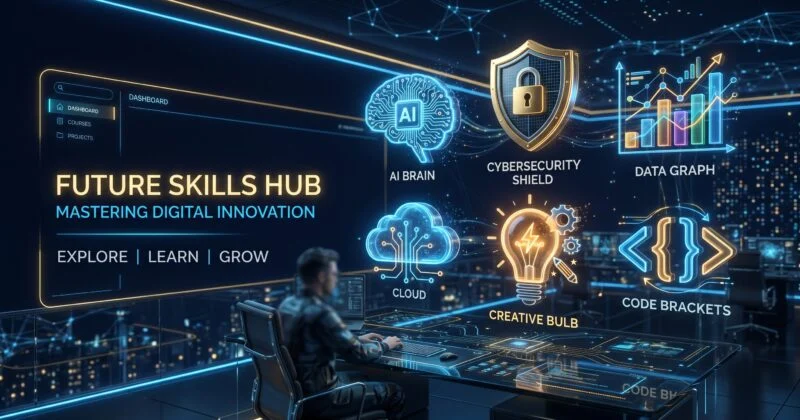
The job market is shifting faster than ever — and in 2026, what you know matters less than what you can do. Degrees are losing their grip. Employers, clients, and platforms are paying premium for people who can execute real skills and deliver measurable results. The World Economic Forum’s Future of Jobs Report 2025 confirmed it bluntly: 170 million new roles will be created by 2030, while 92 million jobs will disappear — and the difference between which side you land on comes down entirely to the skills you build today.
This article gives you the complete, research-backed list of top 10 highest-paying, monetizable skills to learn in 2026 — plus the 5 skills that will completely dominate the next five years (2026–2031). Every skill on this list has a clear path to income: jobs, freelancing, consulting, content, or building your own product. No fluff — just data, salaries, and action plans.
New jobs created by 2030 (WEF)
Core skills will change by 2030
Job postings mention AI skills in 2026
Unfilled cybersecurity jobs globally
YoY growth in Data Science roles
📋 What You Will Read in This Article
- Why Skills Beat Degrees in 2026
- Top 10 Monetizable Skills in 2026 (Detailed Breakdown)
- Skill #1 — AI & Generative AI / Prompt Engineering
- Skill #2 — Cybersecurity
- Skill #3 — Data Science & Analytics
- Skill #4 — Cloud Computing & DevOps
- Skill #5 — Video Creation & Content Marketing
- Skill #6 — Digital Marketing & SEO
- Skill #7 — No-Code / Low-Code Development
- Skill #8 — UX/UI Design
- Skill #9 — Copywriting & AI-Assisted Content
- Skill #10 — Web3 & Blockchain Development
- 5 Skills That Will Dominate the Next 5 Years (2026–2031)
- Your 90-Day Learning Roadmap
- Final Verdict & Action Plan
🎓 Why Skills Beat Degrees in 2026 — The Data Speaks
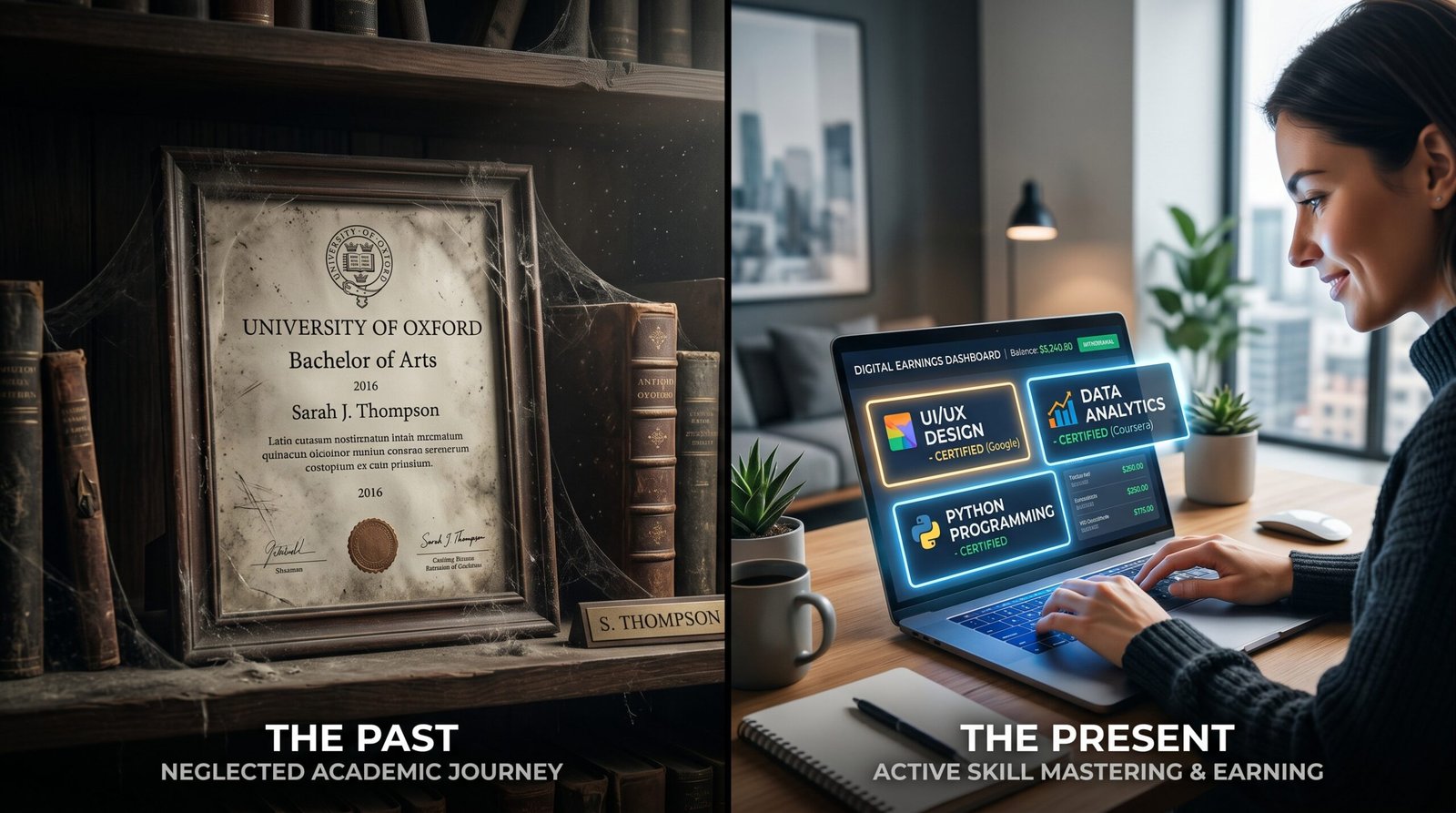
In 2026, a skill-based portfolio earns more than a shelf full of degrees — the market has spoken
The traditional model — get a degree, get a job, climb the ladder — is breaking down faster than most people realize. Here is what the data shows about the 2026 job market:
- Entry-level job postings have fallen 29% since January 2024, according to Randstad’s analysis of 126 million global postings. Companies are no longer hiring untested graduates — they want people who can execute from day one.
- 63% of employers say the skills gap is their #1 barrier to growth, not a talent shortage. There are plenty of people — just not enough skilled ones.
- AI and machine learning professionals earn $30,000–$50,000 more per year than equivalent roles without AI skills. Same job title. Same experience. Just one extra skill set.
- 59 out of every 100 workers will need significant reskilling or upskilling by 2030 (WEF). 11 of those are unlikely to receive it — and face redundancy risk.
- The skills gap will only widen as AI automates repetitive knowledge work. The winners in 2026–2031 are those who build rare, high-value, human-plus-machine skills.
🔥 Top 10 Monetizable Skills in 2026 — Full Breakdown
🤖 AI & Generative AI — Prompt Engineering, AI Tools & Automation

AI skills in 2026 are not about replacing humans — they are about humans who use AI replacing those who don’t
AI and Generative AI top every single list — WEF, LinkedIn, Coursera, and Glassdoor all agree. This is not a trend — it is a fundamental restructuring of how all knowledge work gets done. But the opportunity is bigger than most people realize. It is not just for engineers. Every professional in every industry now needs AI skills — marketing, finance, law, healthcare, education, design, and beyond.
In 2026, the most valuable sub-skills within AI are: Prompt Engineering (crafting precise instructions for AI models to deliver business results), AI Workflow Automation (connecting AI tools with business processes using platforms like Make.com, Zapier, or n8n), AI Agent Building (creating autonomous AI systems that complete multi-step tasks), and AI Ethics & Governance (a rapidly growing corporate compliance need).
Generative AI enrollments on Coursera hit 3.2 million in 2024 alone — averaging six enrollments per minute. India and the USA led globally. The demand signal is clear and the learning window is still open.
🛡️ Cybersecurity — The Skill With 3.4 Million Unfilled Jobs

Cybersecurity is the most talent-starved field in tech — 3.4 million unfilled positions globally with no end in sight
Cybersecurity is the most talent-starved skill in the world right now. With 3.4 million positions unfilled globally — including 750,000 in the USA alone — and cyber attacks becoming more frequent, sophisticated, and costly every year, the demand for cybersecurity professionals is not just growing, it is desperate.
By 2026, 65% of all technical job postings include cybersecurity as a core skill requirement. This is no longer a niche specialisation — it is a baseline expectation across IT, finance, healthcare, government, and retail. Cloud security engineers earn $110,000–$170,000 annually. General roles pay $95,000–$160,000. And the shortage means negotiating power is entirely on the candidate’s side.
Key sub-skills to focus on: Cloud Security (AWS, Azure, GCP security), Zero-Trust Architecture, Incident Response, Ethical Hacking & Penetration Testing, and SIEM tools. Entry certifications like CompTIA Security+ and CEH open the door. Advanced CISSP and OSCP certifications command premium salaries.
📊 Data Science & Analytics — 62% Year-Over-Year Growth in 2026

Data is the new oil — and data scientists are the refiners. The field grew 62% year-over-year in 2026.
Every company — startup or Fortune 500 — is now drowning in data. The ones that turn that data into decisions win. That is exactly what Data Scientists and Analytics Engineers do. The global data science job market is estimated at $178.5 billion, growing at a 26.5% CAGR. US BLS projects a 36% employment growth for data scientists through 2033, generating 20,800+ new openings annually.
The market has split into two tiers: Basic Analysts earn $82,640/year on average. But Analytics Engineers — those who build scalable data pipelines and manage large-scale data systems — command $129,716 or more. That 57% pay premium is entirely driven by the ability to go beyond Excel and SQL into tools like dbt, Airflow, Spark, and Snowflake.
Data visualization is increasingly critical alongside analysis. The ability to tell a story with data — not just interpret it — using tools like Tableau, Power BI, and Python libraries (Matplotlib, Seaborn, Plotly) is what gets analysts promoted into leadership roles.
☁️ Cloud Computing & DevOps — The $168K+ Annual Salary Skill
The world runs on cloud infrastructure — and the demand for people who can build, manage, and secure it is enormous. Cloud engineers earn over $168,000 annually, driven by multi-cloud expertise and automation tools. AWS, Azure, and Google Cloud certifications remain among the highest-ROI credentials you can earn in 2026.
DevOps bridges development and operations — enabling teams to ship software faster and more reliably. With every organisation accelerating its digital transformation, professionals who can set up CI/CD pipelines, containerize applications with Docker and Kubernetes, and manage infrastructure as code with Terraform are commanding premium packages everywhere from startups to enterprise.
Cloud + AI is the most powerful combination right now. Cloud professionals who also understand how to deploy and scale AI models are getting hired at the intersection of both, with compensation packages reflecting that rare overlap.
🎬 Video Creation & Content Marketing — The Creator Economy Skill

The creator economy is projected to hit $480 billion by 2027 — video skills are the most direct path to building income on your own terms
Video is the language of the internet in 2026. YouTube, Instagram Reels, TikTok, LinkedIn video, corporate training content, UGC (User Generated Content) for brands — the demand for skilled video creators has never been higher. Brands are paying $500–$5,000 per UGC video to authentic creators. YouTube channels in competitive niches generate $3,000–$50,000+ per month at scale.
The full skillset includes: video scriptwriting, filming technique, editing (CapCut, Premiere, DaVinci Resolve), thumbnail design, SEO for YouTube, short-form content strategy, and understanding platform algorithms. AI tools like Runway, HeyGen, and ElevenLabs have lowered the barrier for faceless channels and automated content pipelines.
This is also the skill with the highest asymmetric upside. A single viral video can change your financial reality. Content compounds — unlike a salary, a video you made 3 years ago can still generate income today. For those who want to build something on their own terms, video creation is the single most powerful skill to develop.
📣 Digital Marketing & SEO — Evergreen Income Machine
Every business on earth needs customers. Digital marketing is how they get them. This is the broadest and most industry-agnostic skill on this list — a great digital marketer can work for a startup, a hospital, an e-commerce brand, a law firm, or run their own business. No other skill travels this well across industries.
In 2026, the most valuable digital marketing sub-skills are: SEO (Search Engine Optimisation) — particularly for AI-driven search with Google’s SGE and Bing AI, Performance Marketing (Meta Ads, Google Ads), Email Marketing Automation, Conversion Rate Optimisation (CRO), and Analytics + Attribution. AI has transformed the execution layer — but strategy, creativity, and understanding human psychology remain deeply human skills that command premium.
⚡ No-Code / Low-Code Development — Build Without Being a Coder

No-code development lets anyone build apps, automations, and businesses — without writing a single line of traditional code
No-code and low-code platforms have crossed the tipping point. Tools like Bubble, Webflow, FlutterFlow, Glide, Airtable, and Make.com now let non-developers build fully functional web apps, mobile apps, databases, and automated workflows — often faster than traditional developers. In 2026, businesses are actively hiring No-Code Developers because they ship faster and cost less.
This is one of the most accessible high-income skills on this list. You do not need a Computer Science degree. You do not need to understand algorithms. You need problem-solving logic, an eye for design, and the ability to learn platforms quickly — skills that almost anyone can develop with 3–6 months of focused practice.
The highest-earning no-code developers combine this skill with a specific industry niche — healthcare apps, real estate platforms, e-commerce tools, or SaaS products for specific business problems — and charge $5,000–$30,000 per project.
🎨 UX/UI Design — Where Creativity Meets High Salary
Every app, website, and digital product needs great design — and the gap between good and bad UX directly impacts business revenue. UX/UI designers are in consistent demand across every industry that has a digital product, which in 2026 is essentially every industry.
The standard toolkit in 2026 is Figma (the industry standard), supplemented by AI design tools like Galileo AI, Uizard, and Adobe Firefly for rapid prototyping and ideation. UX Research, information architecture, interaction design, and design systems knowledge round out a senior profile.
Interestingly, AI design tools are creating more demand for skilled UX designers, not less. As AI makes basic design easier, companies need human designers to define strategy, conduct user research, and make the creative decisions that AI cannot. Senior UX designers and Product Designers are among the most remote-friendly, well-compensated profiles in the tech industry.
✍️ Copywriting & AI-Assisted Content — Words That Generate Revenue
Copywriting — the art of writing words that persuade people to take action — is one of the oldest and highest-ROI skills in business. In 2026, AI has transformed the execution speed, but the strategic thinking, psychological insight, and brand voice skills of a great copywriter are impossible for AI to replicate fully. The professionals who combine strong copy skills with AI tools are producing 5–10x the output at the same or better quality.
High-value copywriting niches in 2026: Email marketing sequences (direct ROI, easy to measure), Sales pages and landing pages (conversion-critical), LinkedIn thought leadership content (B2B goldmine), Video scripts for YouTube and ads, and SEO content strategies for blogs. Direct response copywriters with proven results can charge $5,000–$20,000 for a single sales page.
🔗 Web3 & Blockchain Development — High Risk, Very High Reward
Web3 and blockchain development carries the highest salary ceiling on this list — $100,000 to $180,000+ annually — because the supply of genuinely skilled developers is extremely limited relative to demand. While the crypto market has cycles, the underlying technology — smart contracts, DeFi protocols, tokenization of real-world assets, and decentralized identity — is being adopted by major financial institutions, governments, and enterprises worldwide.
Solidity (for Ethereum smart contracts), Rust (for Solana), Web3.js, and blockchain architecture knowledge are the core technical skills. Combine this with an understanding of DeFi protocols, NFT standards, and Layer 2 scaling solutions to position yourself at the cutting edge of this field.
This is a harder skill to learn — it requires programming foundations and comfort with cryptographic concepts. But for those willing to invest 6–12 months, the financial reward is among the highest available in the skill economy today.
📋 Quick Reference: All 10 Skills at a Glance
| # | Skill | Salary Range (US) | WEF Priority | Status |
|---|---|---|---|---|
| 1 | AI & Generative AI | $130K–$175K | 🥇 #1 Globally | 🔥 Hottest |
| 2 | Cybersecurity | $95K–$180K | 🥈 #2 Globally | 🔥 Critical Gap |
| 3 | Data Science & Analytics | $82K–$129K | 🥉 #3 Globally | 📈 62% Growth |
| 4 | Cloud Computing & DevOps | $120K–$168K+ | Top 5 | 📈 Strong |
| 5 | Video & Content Creation | $60K–$150K | Top 10 | 🔥 Creator Economy |
| 6 | Digital Marketing & SEO | $55K–$120K | Top 10 | 📈 Evergreen |
| 7 | No-Code / Low-Code Dev | $70K–$130K | Rising | 📈 Accessible |
| 8 | UX/UI Design | $80K–$140K | Rising | 📈 Remote-First |
| 9 | Copywriting & AI Content | $50K–$110K | Evergreen | 📈 AI-Boosted |
| 10 | Web3 / Blockchain Dev | $100K–$180K | Niche-High | 🔥 Highest Ceiling |
🚀 5 Skills That Will DOMINATE the Next 5 Years (2026–2031)
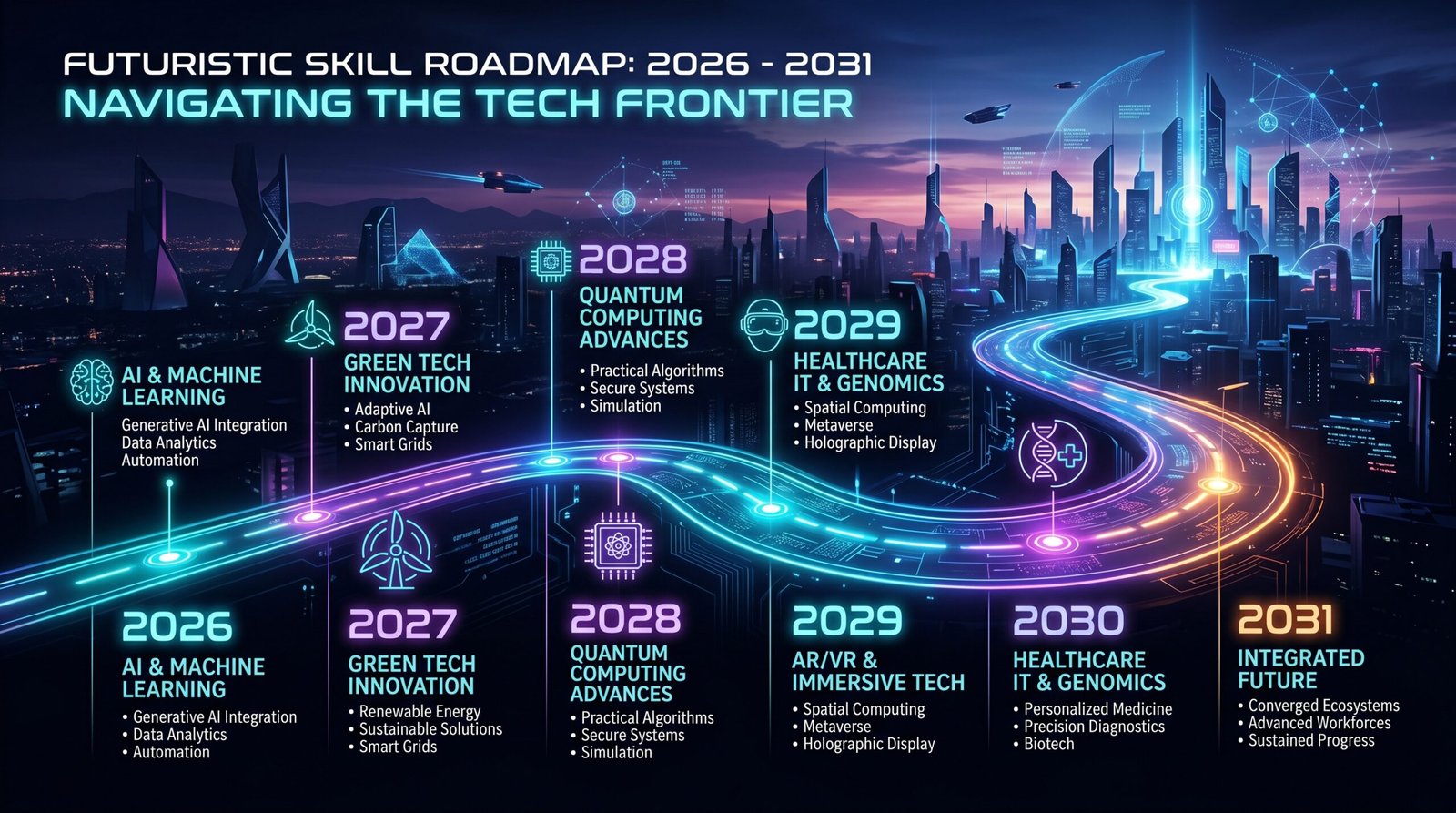
The skills landscape is evolving fast — here are the 5 that will define the next five years and make early learners extremely wealthy
The 10 skills above are in-demand today. But smart career builders are also looking 3–5 years ahead — identifying the skills that are currently emerging but will become dominant and extremely well-compensated by 2028–2031. These are the “get in early” opportunities.
🤖 Agentic AI Development — Building Autonomous AI Systems
In 2025, most people used AI as a chatbot — ask a question, get an answer. In 2026, businesses are moving to Agentic AI: autonomous AI systems that handle entire multi-step business workflows without human intervention. Instead of prompting AI, you build AI agents that plan, act, and complete tasks independently — scheduling, research, email management, data entry, customer service, financial analysis, and more.
WEF data shows businesses are rapidly adopting “Agentic Workflows” — this is where the next wave of AI investment is going. The developers who can build these agents using frameworks like LangChain, AutoGen, CrewAI, and custom LLM pipelines will be among the highest-paid professionals in the world by 2028.
💸 Monetize: Build & sell AI agent systems | Enterprise automation consulting | AI agent SaaS products
🌿 Green Technology & Sustainability Skills
The green economy is not a political preference — it is a $2.1 trillion investment wave that is creating 34 million additional jobs by 2030 (WEF). Renewable energy, carbon accounting, ESG compliance, sustainable supply chain management, green building certification, and clean energy project management are all exploding fields.
Governments and corporations globally are under regulatory pressure to decarbonize. This creates massive demand for professionals who understand both the technical and business sides of sustainability. The WEF 2025 Report ranks environmental stewardship as one of the top 10 fastest-growing skill demands globally — with especially rapid growth in Oil & Gas, Manufacturing, and Chemicals sectors facing forced transition.
💸 Monetize: ESG consulting | Carbon accounting | Renewable energy project management | Sustainability auditing
🏥 Healthcare IT & Bioinformatics
Healthcare is the fastest-growing sector in the WEF’s job projections — and the intersection of healthcare and technology is the most explosive niche within it. Electronic Health Records (EHR) management, AI diagnostics integration, health data standards (HL7, FHIR), HIPAA compliance, bioinformatics for genomics research, and remote patient monitoring systems are all rapidly growing needs.
The aging global population (1 in 5 people will be at retirement age by 2030) combined with AI-driven diagnostic tools and wearable health monitoring is creating an entirely new industry at the intersection of medicine and tech. Professionals who can bridge clinical knowledge and IT implementation are extraordinarily rare — and extraordinarily well-paid.
💸 Monetize: Healthcare IT consulting | EHR implementation | Health data analyst roles | Remote digital health jobs
👓 Spatial Computing — AR, VR & Mixed Reality Development

Agentic AI and spatial computing are the two most transformative emerging skills for 2026–2031
Apple Vision Pro has triggered the spatial computing era. Enterprise applications — employee training in VR, AR-assisted manufacturing and surgery, virtual showrooms, architectural visualization, and immersive education — are rolling out rapidly. Meta, Apple, Microsoft, and dozens of startups are pouring billions into this space.
Spatial computing development using Unity, Unreal Engine, Apple’s visionOS, and WebXR is a skill with very few practitioners relative to the incoming wave of demand. As hardware becomes cheaper and more capable through 2026–2031, spatial computing will become a mainstream platform alongside mobile — and the developers and designers who get in now will have a significant head start.
💸 Monetize: XR app development | Enterprise VR training content | AR product visualization | Spatial design consulting
⚛️ Quantum Computing — The Early Mover Advantage
Quantum computing is not yet a mainstream career skill — but it will be by 2029–2031. IBM, Google, and Microsoft are in a race to quantum supremacy, and the first practical quantum computers will transform cryptography, pharmaceutical research, logistics optimization, and financial modeling. The professionals who understand quantum concepts — even at a basic programming level using Qiskit or Cirq — will have a massive first-mover advantage when corporate hiring in this space opens up at scale.
You do not need to be a physicist. Start with quantum computing fundamentals, linear algebra basics, and Python. The investment of learning this now, when most people have not even thought about it, positions you to be the rare quantum-literate professional that organizations will pay extraordinary amounts to access in 3–5 years.
💸 Monetize: Quantum research roles | Corporate quantum literacy training | Quantum algorithm consulting (by 2029+)
🗓️ Your 90-Day Skill-Building Roadmap — Start Today
🚀 How to Go From Zero to Monetizable in 90 Days
The biggest mistake people make is trying to learn everything. Pick one skill from this list that aligns with your interests and start moving. Here is a simple 90-day framework:
Learn & Build Foundation
Free courses (YouTube, Coursera free tier). Learn core concepts. Build first project. Document everything publicly.
Get Certified + Portfolio
One recognized certification (Google, CompTIA, AWS, Meta, HubSpot). 2–3 portfolio projects. LinkedIn updated.
Get Paid — First Client/Job
Apply for first freelance gig (Upwork/Fiverr) or job posting. First paid project or interview. Iterate and improve.
🏁 Final Verdict — The Only Question That Matters
The data is clear. The skills are identified. The income paths are mapped. The only variable left is you.
By 2030, 92 million jobs will be displaced. But 170 million new ones will be created. The WEF report is not a doom prediction — it is a window of opportunity for anyone willing to invest time in building the right skills. Every single skill on this list has a proven, documented path from zero to income in under six months for a focused learner.
The people who will win the next decade are not the ones with the most impressive degrees. They are the ones who pick a skill, go deep, build evidence of their competence, and put themselves in front of the market. Freelancers, creators, consultants, employees — every path leads to the same starting point: choose one skill and start today.
Bookmark this page. Come back when you need a reminder of why you started. And if this article helped you, share it with someone who needs direction — it might change their trajectory.