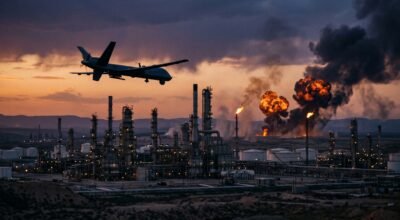
A war that started on the other side of the world is already inside your home — in your cooking gas bill, your petrol price, your grocery costs, and your job market. The US-Iran war of 2026 is not just a geopolitical news story. It is an economic earthquake that every ordinary person on the planet is already feeling, whether they know it or not.
Here is everything you need to understand — clearly, honestly, and without the noise.
What Actually Happened — The Quick Timeline
On February 28, 2026, the United States and Israel launched a massive military operation called “Operation Epic Fury” — striking at least nine cities across Iran in approximately 900 strikes within just 12 hours. The opening strikes killed Iran’s Supreme Leader Ali Khamenei along with dozens of senior officials.
Iran responded immediately — firing hundreds of retaliatory missiles and thousands of drones at targets across the Middle East, hitting Israel, Jordan, Saudi Arabia, Qatar, Kuwait, the UAE, and Bahrain.
Within 24 hours, Iran closed the Strait of Hormuz — the narrow waterway through which approximately 20% of the world’s entire daily oil supply passes. That single decision changed everything for the global economy.
The war is still ongoing as of March 30, 2026, with Iran escalating rather than retreating.
Sources: Wikipedia — 2026 Iran War, Britannica — 2026 Iran Conflict
How It Is Affecting Common People Right Now
1. Your Cooking Gas Bill Just Jumped
India imports 91% of its LPG from the Gulf region. With the Strait of Hormuz effectively shut since March 1, supply chains have been severely disrupted. LPG prices in India jumped by ₹60 per cylinder within days of the conflict starting.
The Indian government ordered refineries to stop producing petrochemicals and divert all propane and butane toward making cooking gas for households — a measure of how serious the shortage has become.
Source: Anand Rathi PMS — US-Iran Conflict India Economy Impact
2. Petrol and Diesel — Held Stable for Now, But Under Pressure
Brent crude oil surged from around $65 per barrel before the war to over $110–$122 per barrel by mid-March 2026 — a jump of more than 40% in just two weeks.
India’s government cut central excise duties on petrol and diesel by ₹10 per litre to shield consumers from the full impact. But this has taken a “huge hit” on government tax revenues, according to Petroleum Minister Hardeep Singh Puri.
Simply put — the government is absorbing the shock for now. But this cannot last forever. If the war continues, fuel price hikes will eventually reach your petrol pump.
Source: CNBC — India Fuel Tax Cut
3. Grocery Prices Are Rising
This is the impact most people have not connected yet. The Gulf region is a major supplier of urea, ammonia, and other chemical fertilisers that farmers across the world depend on for crop production. Since the war began, fertiliser prices have risen by up to 40%.
This matters because spring planting season has begun across the Northern Hemisphere. Farmers from India to Canada are making purchasing decisions right now against a backdrop of price spikes. Weaker crop yields in the coming months are a real possibility — which means higher food prices at your local market.
Source: World Economic Forum — The Global Price Tag of War
4. The Rupee Hit a Record Low
The Indian rupee slumped to a record low of ₹94.7875 per dollar as the war disrupted remittances and energy imports. India’s stock market fell for five consecutive weeks as oil and gas prices continued to rise.
A weaker rupee means everything India imports becomes more expensive — electronics, medicines, industrial equipment, and of course oil. The ripple effect eventually reaches everyday consumers.
Source: Christian Science Monitor — Iran War Costs India
5. Flights Got Disrupted
Dubai International Airport — one of the world’s busiest — was damaged by drone strikes and temporarily halted all flights. Airlines began rerouting to avoid the entire Middle East region. For Indians traveling to or from Gulf countries for work or family visits, disruptions have been significant.
Aviation turbine fuel (ATF) accounts for 30–40% of airline operating costs. With oil above $100 per barrel, airlines like IndiGo are already feeling severe margin pressure — which will eventually mean higher ticket prices.
Source: Britannica — 2026 Iran Conflict
How It Is Affecting the Tech Industry
1. High-Tech Supply Chains Are Already Disrupted
It is not just oil that passes through the Strait of Hormuz and the broader Gulf region. According to the Council on Foreign Relations, high-tech supply chains are also being negatively affected — widening the crisis beyond energy alone.
Semiconductors, electronics components, and rare materials used in manufacturing move through these shipping lanes. Any prolonged disruption adds cost and delay to the entire global electronics supply chain — which means your next smartphone or laptop could cost more and take longer to arrive.
Source: Council on Foreign Relations — Iran War Geoeconomic Firestorm
2. Cybersecurity Threats Are Escalating
According to CSIS analysts, Iran is executing a “multidomain punishment campaign” targeting energy, cyber, and maritime systems simultaneously. Cyberattacks are a core part of Iran’s retaliatory strategy.
Iranian state-sponsored hackers have historically targeted critical infrastructure — power grids, banking systems, and government databases. In a prolonged conflict, the risk of major cyberattacks on global financial systems, tech companies, and government infrastructure rises significantly.
Source: CSIS — Latest Analysis: War with Iran
3. India’s Private Sector Activity Hit Its Lowest Since 2022
HSBC’s flash Purchasing Managers’ Index released in March 2026 showed that India’s private sector activity slowed to its lowest level since October 2022. Companies cited the Middle East conflict, unstable market conditions, and intensifying inflation as the primary reasons.
Cost inflation is now near a four-year high in India. For tech startups and IT companies that depend on stable economic conditions and investor confidence, this is a serious warning signal.
Source: CNBC — India Economy Iran War Impact
4. The Energy Crisis Is Forcing a Faster Shift to Renewables
Every major energy crisis in history has accelerated the shift away from fossil fuels. This one will be no different. The New Lines Institute notes that countries heavily dependent on Gulf energy — including India — will be pushed harder and faster toward renewable energy investments.
For the tech industry, this means an accelerating boom in clean energy technology, electric vehicles, solar infrastructure, and battery technology. Skills in these areas will be in high demand in the coming years.
Source: New Lines Institute — The Energy Shock
What If It Escalates Further? Worst Case Scenarios
The situation as of March 30, 2026 is already serious. But analysts are warning that further escalation could make things significantly worse.
Scenario 1 — Oil Hits $150 Per Barrel
The International Monetary Fund has warned that every 10% increase in energy prices adds almost 0.5% to global inflation. If oil reaches $150 per barrel — which analysts say is possible if the Strait of Hormuz remains disrupted — global inflation would spike dramatically.
For India, Bloomberg analysts warn this could cut GDP growth by more than 1%, push inflation well above the RBI’s tolerance level, and force emergency interest rate decisions.
Source: Bloomberg — India Economy Growth Risks
Scenario 2 — Global Recession
The Stimson Center warns that a worst-case scenario — a major war spilling over to impact shipping from multiple Gulf states — could send prices skyrocketing and trigger a global recession.
The European Central Bank has already warned that a prolonged conflict will likely push major energy-dependent economies including Germany and Italy into technical recession by the end of 2026.
Source: Stimson Center — Experts React to Epic Fury
Scenario 3 — Food Crisis
The World Economic Forum warns that the fertiliser shock from this war could be more devastating than the energy shock — but has received far less media attention. With fertiliser prices up 40% at the start of planting season, crop yields across India, Africa, and the Americas could be significantly weaker later in 2026.
Weaker crops mean higher food prices — affecting the poorest populations most severely.
Source: World Economic Forum — Global Price Tag of War
What Should You Do Right Now?
You cannot control geopolitics. But you can make smarter decisions in response to the situation.
- Track your fuel and gas bills closely. If the war continues, subsidies may eventually be removed and prices will rise. Budget accordingly.
- Be cautious with large purchases. If you were planning to buy a new laptop, smartphone, or vehicle, be aware that prices may rise if supply chains get further disrupted.
- Learn skills that are recession and crisis-proof. Cybersecurity, cloud computing, AI, and renewable energy technology are the fields that will see the most demand even during economic downturns.
- Diversify your income. This crisis is a reminder that depending on a single source of income is risky. Online income streams — blogging, freelancing, affiliate marketing — are more resilient than traditional jobs in times of economic uncertainty.
- Stay informed from reliable sources. Avoid WhatsApp forwards and social media panic. Stick to sources like CFR, CSIS, Bloomberg, and established Indian news outlets.
The Bottom Line
The US-Iran war of 2026 is the most significant geopolitical and economic disruption since the COVID-19 pandemic — and by some measures, potentially worse for global energy markets. The International Energy Agency has called it the “greatest global energy security challenge in history.”
For everyday Indians, the impact is already visible in cooking gas prices, a weakening rupee, rising food costs, and a slowing economy. For the tech industry, supply chain disruptions, rising costs, and cybersecurity threats are the immediate concerns.
Whether this escalates into a broader global crisis or is contained through diplomacy in the coming weeks will determine how the rest of 2026 unfolds for all of us.
We will keep updating this article as the situation develops. Bookmark this page and check back.
Sources
- Wikipedia — 2026 Iran War
- Britannica — 2026 Iran Conflict
- Council on Foreign Relations — Global Conflict Tracker
- Council on Foreign Relations — Geoeconomic Firestorm
- Stimson Center — Experts React: Epic Fury
- CSIS — Latest Analysis: War with Iran
- Al Jazeera — Geopolitical Analysis
- World Economic Forum — Global Price Tag of War
- CNBC — India Fuel Tax Cut
- Bloomberg — India Growth at Risk
- New Lines Institute — The Energy Shock
- Christian Science Monitor — Iran War Costs India
- Anand Rathi PMS — India Economy Impact