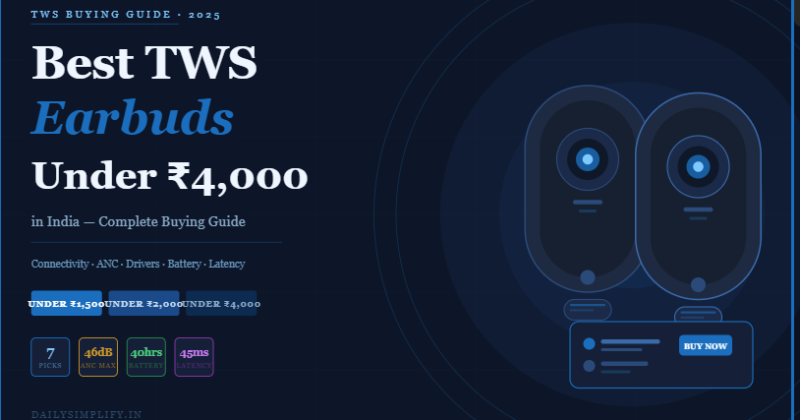
Best TWS Earbuds Under ₹4,000 in India — Complete Buying Guide
Everything you need to know before buying wireless earbuds — ANC, drivers, battery, latency — plus our top picks for every budget.
TWS earbuds have completely taken over. Walk down any street, sit in any metro, visit any café — and you will see people wearing them. The bulky neckbands and tangled wired earphones of yesterday have been quietly replaced by these compact, wireless pods that sit snugly in your ears and just work. And honestly? The reason is simple. They are comfortable, easy to use, and the battery life has gotten genuinely good.
But here is a piece of advice before we get into the specifics — one that most tech reviewers will not tell you upfront: 99% of people have no business spending more than ₹5,000 on TWS earbuds. The average lifespan of a pair of TWS earbuds is roughly 1.5 to 2 years. Battery health degrades, charging cases wear out, and — let us be honest — a significant number of people simply lose one earbud. Given this reality, the sweet spot for value lies firmly under ₹4,000, where the options today are genuinely impressive. This guide will walk you through exactly what to check before buying, followed by the best picks at every price point.
1. Connectivity & Compatibility — Start Here
Most buyers jump straight to sound quality. That is a mistake. The single most frustrating experience with any TWS earbud is a pairing problem — your earbuds not connecting when you want them to, or failing to switch seamlessly between your phone and laptop. Before anything else, check the Bluetooth version.
If you are buying in 2025 or beyond, your TWS should have at minimum Bluetooth 5.3, and ideally 5.4. These newer versions offer significantly faster pairing, more stable connections, and better compatibility with a wider range of devices. Older Bluetooth 5.0 or 5.1 earbuds in the sub-₹2,000 segment can be hit or miss when it comes to reconnecting reliably — do not settle for that frustration.
Min. Bluetooth Version
Look for This Feature
Ideal Connectivity
2. Audio Drivers — Size Matters
The driver is the heart of any earphone — it is the component that physically produces the sound. Larger drivers move more air, which generally translates to deeper bass, more dynamic range, and a fuller overall sound signature.
For TWS earbuds in the budget segment, here is a practical rule of thumb: aim for a single driver of at least 12mm. Earbuds with 12mm to 12.4mm drivers consistently outperform their smaller-driver counterparts in the sub-₹5,000 category. If a pair uses dual drivers, look for a 9–10mm dual configuration, which can also deliver excellent results. Earbuds with 8mm or smaller single drivers tend to sound thin and underwhelming — not worth your money regardless of how the rest of the specs look.
3. Active Noise Cancellation — Do Not Get Fooled
ANC has become a major marketing buzzword in the affordable TWS segment, and that is where buyers need to be careful. Many earbuds in the ₹2,000–₹4,000 range advertise ANC prominently, but when you actually enable it, the difference is negligible — almost theatrical. Real ANC should noticeably reduce ambient noise: traffic, office chatter, the hum of an air conditioner.
Also look for a Transparency Mode — the ability to let outside sound in on demand. This is particularly useful when crossing roads, having quick conversations, or simply staying aware of your environment without removing your earbuds. A good pair of earbuds in 2025 should offer both genuine ANC and a functional transparency mode.
4. Battery Performance — Know the Minimum
Battery life is often the deciding factor for daily users. TWS earbuds have two battery metrics: the earbud themselves, and the total capacity including the charging case. Both matter.
A good pair of earbuds should give you at least 4 to 4.5 hours of continuous playback on a single charge. Anything under 3 hours is simply not enough for a full commute or work session. The charging case should provide a total battery backup of at least 40 hours, meaning you can go several days without reaching for a cable. Earbuds that only offer 25–30 hours total are borderline acceptable — look for 40+ as your benchmark.
Single Use Minimum
Total (with Case)
5. Low Latency Mode — Critical for Gamers
If you use your earbuds for mobile gaming, low latency mode is not optional — it is essential. Audio latency refers to the delay between what happens on screen and what you hear. In casual music listening, a small delay is imperceptible. But in gaming, even a 100–150ms delay makes gunshots, footsteps, and in-game cues feel completely out of sync, ruining the experience entirely.
Look for earbuds with a dedicated low-latency gaming mode that achieves 45ms or lower. This is the threshold below which the delay becomes genuinely imperceptible during gameplay. Several options in this guide hit that mark without requiring you to spend a fortune.
6. Water Resistance & Durability
If you plan to use your earbuds during workouts, runs, or in unpredictable weather, water resistance is non-negotiable. Sweat is surprisingly corrosive to electronics over time, and a single caught-in-the-rain moment can permanently damage earbuds that lack proper sealing.
The industry standard for this is the IP rating. For active outdoor use, aim for at minimum an IP54 or IP55 rating. IP54 means protection against dust and splashing water from any direction — more than sufficient for gym sessions and light rain. An IP55 rating adds protection against low-pressure water jets, which is ideal for more intense outdoor workouts.
7. Bonus: App Compatibility & Warranty
Two factors that buyers frequently overlook until it is too late. First, companion app support: a dedicated app unlocks equalizer settings, touch control customization, firmware updates, and sometimes additional ANC modes. If audio personalization matters to you, verify that your chosen earbuds have a well-rated companion app before purchasing.
Second, and just as important — warranty coverage. Budget earbuds break. Hinges crack, charging pins corrode, and earbuds stop responding. A solid 1-year warranty with accessible service centres can save you from having to replace them entirely. Always factor warranty terms into your buying decision as seriously as any spec on the list.
Under ₹1,500
OnePlus Nord Buds 3R
The OnePlus Nord Buds 3R is the strongest argument you can make for the sub-₹1,500 segment. Equipped with Bluetooth 5.4 — a rarity at this price — it offers the fastest and most reliable pairing in its class. The 45ms low-latency gaming mode is a genuine highlight, delivering near-instant audio sync that makes a noticeable difference in mobile gaming. Battery life is competitive, and the overall build quality feels distinctly above its price point. If you want a reliable, everyday earbud without spending a rupee more than necessary, this is the one to start with.
Under ₹1,500
Realme Buds T310
For users who prioritize noise cancellation above all else in the budget tier, the Realme Buds T310 is a compelling choice. Its 46dB hybrid ANC is among the highest-rated in the sub-₹1,500 category — and crucially, it is ANC that actually works, not just a marketing number. The hybrid implementation combines feedforward and feedback microphones for more effective ambient noise reduction compared to single-microphone setups. It also includes a low-latency mode, making it a well-rounded option for both commuters and casual gamers on a tight budget.
Under ₹2,000
CMF Buds 2A
CMF by Nothing has rapidly established itself as one of the most exciting budget audio brands in India, and the Buds 2A perfectly encapsulates why. The 42dB active noise cancellation is genuinely effective, not token. But the real standout is the battery life — 23 hours with ANC enabled, and a remarkable 35.5 hours without. For anyone who travels frequently or works in loud environments, these figures are exceptional for the price. The quad-microphone setup also makes this an excellent choice for professionals who take a lot of calls. At under ₹2,000, this is a difficult package to beat.
Under ₹2,000
Oppo Enco Buds 3 Pro+
The Oppo Enco Buds 3 Pro+ is an often-overlooked gem in the ₹2,000 segment. Armed with Bluetooth 5.4 for the most stable wireless connection in its tier, it also delivers 32dB ANC — functional and effective for everyday use. The battery performance is strong: 28 hours total with ANC enabled and a claimed 43 hours without. If you are an Oppo or OnePlus user, the seamless integration with the HeyMelody app for EQ customization makes this an especially attractive pick. Clean, reliable, and well-designed at this price.
Under ₹3,000
Realme Buds 7
When your budget stretches to ₹2,500–₹3,000, the Realme Buds 7 is where audio quality takes a meaningful leap forward. The inclusion of special audio codec support (LDAC/AAC) means you are getting noticeably richer, more detailed sound compared to earbuds that rely on basic SBC transmission alone. The battery life is exceptional — 6 to 10 hours of playback per charge depending on usage — which puts it well above the average in this segment. Combine that with effective ANC and Realme’s polished companion app, and the Buds 7 justifies every rupee of the upgrade over the budget tier.
Under ₹4,000
CMF Buds 2 Plus
The CMF Buds 2 Plus steps up the Buds 2A formula with improved drivers, refined ANC, and a more premium build quality. Nothing’s design language — minimalist, distinctive, and instantly recognizable — makes these stand out visually as well. For buyers who want the CMF ecosystem experience with more performance headroom, the Buds 2 Plus at around ₹3,300 hits a sweet spot that few competitors can match at this price point.
Under ₹4,000
JBL Wave Beam 2
JBL is a brand that has earned its audio credentials over decades, and the Wave Beam 2 brings that legacy to the sub-₹4,000 bracket. The 8mm dual dynamic driver configuration delivers JBL’s characteristic punchy, bass-forward sound signature — which still manages to stay balanced enough for non-bass-heads. The quad-microphone array ensures clean call quality with effective environmental noise suppression. Google Fast Pair support means Android users get instant one-tap pairing, and the ANC — while not class-leading — is dependable. If you trust brand heritage and want a versatile all-rounder, the Wave Beam 2 is hard to overlook at ₹3,999.
Quick Comparison — All Picks at a Glance
| Earbuds | Key Feature | ANC | Battery | Price | Buy |
|---|---|---|---|---|---|
| OnePlus Nord Buds 3R | BT 5.4, 45ms Gaming | — | Competitive | ~₹1,299 | Amazon ↗ |
| Realme Buds T310 | 46dB Hybrid ANC | 46dB | Good | ~₹1,299 | Amazon ↗ |
| CMF Buds 2A | 35.5 hrs battery, 4 mics | 42dB | 35.5 hrs total | ~₹1,799 | Amazon ↗ |
| Oppo Enco Buds 3 Pro+ | BT 5.4, 43 hrs total | 32dB | 43 hrs total | ~₹1,999 | Amazon ↗ |
| Realme Buds 7 | LDAC, 6–10 hrs use | Yes | 6–10 hrs/use | ~₹2,499 | Amazon ↗ |
| CMF Buds 2 Plus | Premium CMF build | Yes | Good | ~₹3,299 | Link Soon |
| JBL Wave Beam 2 | Dual driver, Google Fast Pair | Yes | Good | ~₹3,999 | Amazon ↗ |
Final Verdict — Which One Should You Buy?
For most people, the decision comes down to two questions: what is your budget, and what matters most to you? If you are a gamer on the tightest possible budget, the OnePlus Nord Buds 3R is the obvious answer — Bluetooth 5.4 and 45ms latency at ₹1,299 is genuinely remarkable. If ANC is your priority at the same price, the Realme Buds T310‘s 46dB hybrid cancellation is the best in its tier.
Step up to ₹2,000 and the CMF Buds 2A becomes the clear value champion — outstanding battery life, quad microphones, and effective ANC in one package. For Oppo ecosystem users, the Enco Buds 3 Pro+ is a polished alternative at the same price.
If audio quality is non-negotiable, stretch to the Realme Buds 7 for LDAC codec support and superior per-charge battery life. And if you want the most complete package under ₹4,000 with the credibility of a globally recognized audio brand, the JBL Wave Beam 2 delivers on every front.
Whatever you choose, every option on this list respects your money. In 2025, there is simply no reason to spend more than ₹5,000 on a pair of TWS earbuds — and this list proves exactly why.