🚀 Technology · Space · Breaking News
Humans Are Flying to the Moon Right Now — And It’s the Biggest Moment in Space Since 1972
NASA’s Artemis II launched April 1. Four astronauts are heading to the Moon tomorrow. Here is everything happening — explained simply.
📅 April 5, 2026
⏱ 12 min read
🔴 LIVE — Mission Day 4
✅ All facts verified from NASA
Day 4
Mission elapsed time
4
Astronauts aboard Orion
54 yrs
Since humans went this far

Inside the Orion spacecraft — astronauts working in deep space on their way to the Moon. This is the view from inside humanity’s most advanced crewed spacecraft, currently 200,000+ miles from Earth. (Artist impression)
Right now, as you read this, four human beings are travelling through deep space towards the Moon. They launched 4 days ago. They will fly within 6,000 miles of the lunar surface tomorrow — April 6, 2026 — for the first time since Apollo 17 in 1972. This is not a drill. This is really happening.
What Just Happened — The Launch That Changed Everything
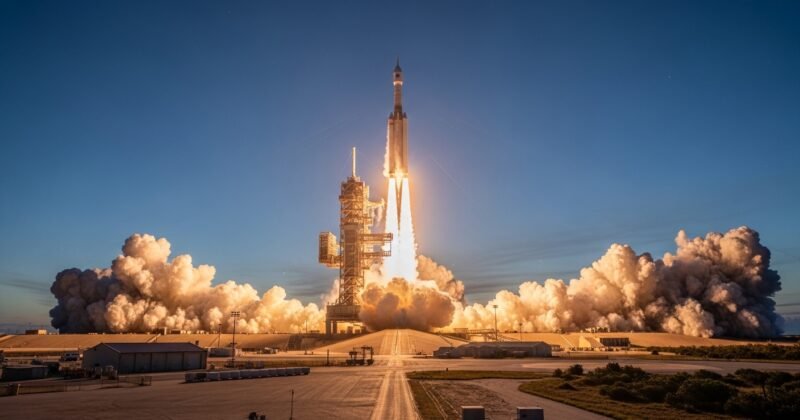
On April 1, 2026 at 6:35 PM Eastern Time, NASA’s Space Launch System rocket — the most powerful rocket ever built — lifted off from Launch Pad 39B at Kennedy Space Center in Florida. Aboard the Orion spacecraft were four astronauts: Reid Wiseman, Victor Glover, Christina Koch, and Canadian Jeremy Hansen.
Within 49 minutes of launch, the upper stage fired to place Orion into an elliptical orbit around Earth. Then came the critical moment: the Translunar Injection burn — a six-minute engine firing that broke the spacecraft free from Earth’s gravitational hold and sent it hurtling toward the Moon. It was the first time humans had departed Earth orbit since Apollo 17 in December 1972.
🤯 Let that sink in
The last time any human being travelled beyond low Earth orbit was December 14, 1972 — when Apollo 17’s Gene Cernan lifted off from the Moon’s surface. That was 53 years, 3 months, and 18 days ago. The humans now heading toward the Moon were not yet born when we last did this.

Earth — seen through the Orion spacecraft window from deep space. This is what the Artemis II crew saw after completing their Translunar Injection burn on April 2, 2026, becoming the first humans to leave Earth’s orbit in 54 years. Africa and the Indian Ocean visible below the clouds. (Artist impression based on mission imagery)
Commander Reid Wiseman’s words from the moment of launch have already become iconic. As the rocket rose and the Moon appeared in the window, he said simply: “We have a beautiful moonrise. We’re heading right at it.”
8.8M
Pounds of thrust at liftoff
46,000
Miles — high Earth orbit altitude
248,655
Miles — Apollo 13 distance record they may break
Meet the 4 Astronauts Who Are at the Moon Right Now
Every one of the four astronauts aboard Orion is making history. This mission sets multiple records simultaneously — a first for a woman, a first for a person of colour, a first for a non-American, and a first for someone of Wiseman’s age to travel beyond low Earth orbit.

The Artemis II crew — (left to right) Victor Glover, Reid Wiseman, Christina Koch, and Jeremy Hansen — pictured in their orange NASA launch and entry suits. Each member of this crew is setting a record no human has set before. (Illustration)
RW
Reid Wiseman
Commander · NASA
US Navy test pilot. Two space station missions. Led the crew through the critical TLI burn. Named the spacecraft “Integrity.”
🏆 Oldest person beyond low Earth orbit
VG
Victor Glover
Pilot · NASA
US Navy aviator. Previously flew on SpaceX Crew-1 to the ISS. Now heading further from Earth than any person of colour in history.
🏆 First person of colour beyond low Earth orbit
CK
Christina Koch
Mission Specialist · NASA
Holds the record for the longest single spaceflight by a woman — 328 days on the ISS. Expert in spacewalks and deep-space science.
🏆 First woman to travel beyond low Earth orbit
JH
Jeremy Hansen
Mission Specialist · Canadian Space Agency
Former Canadian fighter pilot. First Canadian — and first non-American — to travel to the lunar vicinity in history.
🏆 First non-American beyond low Earth orbit
The Complete Mission — What Happened Each Day
Here is the full Artemis II mission timeline, updated to today — April 5, 2026, Mission Day 4:
✓
Day 1 — April 1 ✓ DONE
Launch + Earth Orbit Entry
SLS launched at 6:35 PM EDT from LC-39B. Orion’s four solar array wings deployed. Upper stage fired to place spacecraft in elliptical high Earth orbit. Crew began checking all systems for the first time with humans aboard.
✓
Day 2 — April 2 ✓ DONE
Translunar Injection — Breaking Free of Earth
The most critical moment: a 5-minute 55-second burn of Orion’s main engine sent the spacecraft beyond Earth orbit for the first time since 1972. Earth viewed from deep space for the first time with a crew in 54 years.
✓
Day 3 — April 3 ✓ DONE
Halfway to the Moon + System Checks
First outbound trajectory correction burn cancelled — spacecraft trajectory perfect. Crew exercised, practiced CPR in zero gravity, tested emergency comms in deep space. Minor: crew reported “burning smell” from toilet — Mission Control cleared it as non-concerning.
→
Day 4 — April 4–5 🔴 CURRENT
Final Preparations for Lunar Flyby
Crew preparing Orion’s cabin for the lunar observation period. Practicing Moon photography. Studying lunar surface targets. Spacecraft more than halfway to the Moon on a perfect trajectory.
→
Day 6 — April 6 ⏳ TOMORROW
🌕 THE MOON FLYBY — The Historic Moment
Orion reaches its closest approach — approximately 4,000 to 6,000 miles from the lunar surface. The crew will photograph the lunar surface including areas of the far side never seen directly by humans. The closest humans have been to another world since 1972.
→
Days 7–9 — April 7–9 ⏳ UPCOMING
Return Journey — Deep Space Science
Orion loops around the Moon on a free-return trajectory. Crew conducts deep-space science experiments including AVATAR — studying effects of radiation on human tissue.
→
Day 10 — April 10 ⏳ UPCOMING
Re-entry + Splashdown in Pacific Ocean
Orion re-enters Earth’s atmosphere at approximately 25,000 mph. Splashdown in the Pacific Ocean off the coast of San Diego. Mission complete.
The Moon Flyby Tomorrow — What Will Actually Happen
Tomorrow, April 6, is the day everyone has been waiting for. Orion will use a free-return trajectory — a giant figure-eight path that uses the Moon’s gravity to slingshot the spacecraft back toward Earth without needing a major engine burn. At closest approach, the four astronauts will be approximately 4,000 to 6,000 miles from the Moon’s surface.

The lunar surface — a world of ancient craters, ridges, and deep shadows. This is what the Artemis II crew will see from their windows tomorrow, April 6, when Orion passes within 6,000 miles of the Moon. The crew will photograph these exact features, including parts of the far side never seen directly by human eyes. The low-angle sunlight creates extreme shadows that reveal depth invisible in photos taken from Earth.
📸 What the crew will photograph tomorrow
NASA has given the crew specific lunar surface targets to photograph during the flyby. The oblique lighting conditions — where shadows stretch across craters — will reveal surface details normally invisible. This includes areas of the Moon’s far side that have only ever been seen in photographs taken by robotic spacecraft, never by human eyes. The crew will take high-resolution photographs that scientists will study for months.
“For the first time since Apollo 17 in 1972, humans have departed Earth orbit. Reid, Victor, Christina, and Jeremy now are on a precise trajectory toward the Moon.”
— NASA official statement, April 2, 2026
Why This Moment Matters So Much
For 54 years after Apollo, the Moon sat there — visible to everyone on Earth, 238,855 miles away, unchanged. We did not go back. Generation after generation grew up being told that humans had been to the Moon without ever seeing it happen themselves. Today’s 50-year-olds were born before the last Moon landing.
Artemis II is the proof that we are going back. It is not just a test flight — though it is technically that. It is the moment humanity demonstrates that the equipment works, the systems work, the life support works, and that humans can survive in deep space beyond Earth’s magnetic field.
🌍 Why deep space is different from the ISS
The International Space Station orbits at about 250 miles altitude, still inside Earth’s magnetosphere — which provides significant protection from cosmic radiation. The Moon is 238,855 miles away. Beyond the magnetosphere, astronauts are exposed to radiation levels that are fundamentally different. Artemis II is the first test of whether Orion’s life support, shielding, and systems can protect humans in this environment. That data is essential before anyone lands on the Moon.
Artemis II vs Apollo — How Do They Compare?
| Feature |
Apollo 8 (1968) |
Apollo 17 (1972) |
Artemis II (2026) |
| Mission type |
Crewed lunar orbit |
Crewed Moon landing |
Crewed lunar flyby |
| Crew size |
3 astronauts |
3 astronauts |
4 astronauts |
| Rocket thrust |
Saturn V — 7.6M lbs |
Saturn V |
SLS — 8.8M lbs |
| Duration |
6 days |
12 days |
~10 days |
| Communication |
Radio only |
Radio + TV |
High-speed digital + 4K video |
| International crew |
USA only |
USA only |
USA + Canada |
| Records broken |
First humans to Moon orbit |
Last Moon landing |
First woman + person of colour + non-American near Moon |
What Comes After — The Road to Moon Landing 2028
🔗
2027
Artemis III — Lander Docking Tests
Orion docks in low Earth orbit with SpaceX’s Starship HLS and Blue Origin’s Blue Moon lander — testing docking without landing.
🌕
2028
Artemis IV — First Moon Landing
First crewed Moon landing since Apollo 17 in 1972. Near the south pole — rich in water ice, completely unexplored by Apollo.
🏠
2030s
Permanent Lunar Base
NASA plans annual Moon landings building toward a permanent south pole base — the stepping stone for Mars missions.
What This Means for India and ISRO
India is not watching this from the sidelines. ISRO is actively preparing for its own human spaceflight moment. The Gaganyaan programme is targeting India’s first uncrewed test flight this year, with a crewed mission planned for 2027. India has already contributed — astronaut Shubhanshu Shukla flew to the ISS as part of Axiom Mission 4 in 2025, India’s first human spaceflight since Rakesh Sharma in 1984.
🇮🇳 India’s space milestones on the horizon
2026: Gaganyaan-1 uncrewed test — India’s first human-rated spacecraft
2027: First Indian astronaut in space aboard Gaganyaan
2028: Chandrayaan-4 — India’s first lunar sample return mission
2035: Indian Space Station — the long-term vision
India signed the Artemis Accords — when humans establish a permanent presence on the Moon, India will be part of the governing architecture of how that happens.
Quick Facts — Everything in One Place
| Question |
Answer |
| When did Artemis II launch? |
April 1, 2026 at 6:35 PM EDT from Kennedy Space Center |
| Who is on board? |
Reid Wiseman, Victor Glover, Christina Koch (NASA) + Jeremy Hansen (Canada) |
| When is the Moon flyby? |
April 6, 2026 — Tomorrow |
| How close to the Moon? |
4,000–6,000 miles from the lunar surface |
| Will they land on the Moon? |
No — this is a flyby test mission, not a landing |
| When do they come home? |
April 10, 2026 — Splashdown in Pacific Ocean near San Diego |
| How long since humans were this far? |
54 years — Apollo 17, December 1972 |
| What is the rocket called? |
Space Launch System (SLS) — most powerful rocket ever built |
| What is the spacecraft named? |
Orion — crew named it “Integrity” |
| When will humans land on Moon? |
2028 — Artemis IV mission |
| How to follow live updates? |
nasa.gov/artemis and @NASAArtemis on all platforms |
The Bigger Picture
Tomorrow, April 6, 2026, four people will fly past the Moon. They will look out of a spacecraft window and see the lunar surface scrolling past — with their own eyes, from closer than any human has been since December 1972. This is a moment worth paying attention to. Whatever happens on the Moon in the years ahead — the landing in 2028, the base in the 2030s, the Mars missions in the 2040s — begins with this week.
🌕 When to watch the Moon flyby
The Artemis II lunar flyby is scheduled for April 6, 2026. NASA provides live coverage at nasa.gov/live and their YouTube channel. The closest approach happens in the morning hours EDT. Set a reminder — you will not want to miss this one.
🚀 History is happening right now — share this
Humans are flying to the Moon for the first time in 54 years. Tell someone who should know about this.
Read Next on DailySimplify