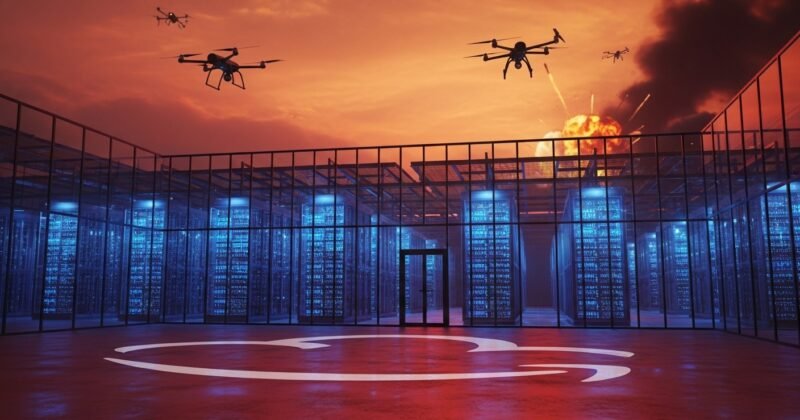

On March 1, 2026, the world woke up to something that nobody in Silicon Valley, New Delhi, or Washington D.C. had fully prepared for. Iranian Shahed drones struck three Amazon Web Services (AWS) data centers — two in the United Arab Emirates and one in Bahrain — in the first known military attack ever launched against a major American cloud provider. The cloud was no longer abstract. It had an address. And that address got bombed.
This wasn’t just another geopolitical headline. It was a turning point — the moment when global warfare and the digital world collided at full speed. If you use a mobile app, stream content, make digital payments, or rely on any online service, you are connected to this story.
🔥 What Actually Happened: The AWS Attack Explained
The attack came as a direct retaliation for Operation Epic Fury — a joint U.S.-Israeli military strike on Iran. Iran’s Islamic Revolutionary Guard Corps (IRGC) claimed responsibility, stating the Amazon data centers were “legitimate targets” because the U.S. military was using AI systems hosted on AWS — including Anthropic’s Claude — for intelligence analysis, target identification, and war simulations.
AWS confirmed in a public dashboard update that the strikes caused “structural damage, disrupted power delivery, and in some cases required fire suppression activities that resulted in additional water damage.” Services went dark for banks, payment platforms, delivery apps, and enterprise software across the Middle East.
The real-world damage was immediate and widespread. Abu Dhabi Commercial Bank, Emirates NBD, First Abu Dhabi Bank, payments platform Alaan, ride-hailing giant Careem, and data cloud company Snowflake — all reported outages. AWS later took the extraordinary step of waiving all usage charges for the ME-CENTRAL-1 region for the entire month of March 2026 — an unprecedented move in the history of cloud computing.

🌍 The Bigger Picture: Wars Reshaping the Tech World in 2026
The AWS attack does not exist in isolation. In 2026, the world is running multiple active and near-active war zones simultaneously — and every one of them is hitting the technology sector hard.
1. The Iran–U.S.–Israel War and the Strait of Hormuz Crisis
Iran’s blockade of the Strait of Hormuz — through which nearly 20% of the world’s oil trade passes — has sent energy prices skyrocketing. Brent crude jumped 15% to $83/barrel by early March. This directly increases the electricity costs of running data centers globally, squeezing already-tight margins for cloud providers. The conflict has also targeted submarine cable routes in the Red Sea, where 17 submarine cables carry the majority of data between Europe, Asia, and Africa.
Making matters worse, tungsten — a material essential for semiconductor manufacturing and precision electronics — has seen its price surge over 50% since March 2026, with China (which controls 80% of global tungsten production) restricting exports in the geopolitical fallout.
2. Russia–Ukraine War: Three Years of Tech Disruption
Now in its fourth year, the Russia-Ukraine war has become a live laboratory for modern tech warfare. Drone swarms, AI-assisted targeting, satellite-based communication (Starlink), and cyberattacks have all been deployed at scale. The Crisis24 Global Risk Forecast 2026 notes that Russia is successfully driving a wedge between the U.S. and European NATO allies — creating ripple effects on global tech supply chains, energy infrastructure, and cross-border data flows.
3. China–Taiwan Tensions and the Semiconductor Threat
Taiwan produces a dominant share of the world’s advanced semiconductors. Any military escalation in the Taiwan Strait wouldn’t just be a geopolitical crisis — it would be a global tech supply chain catastrophe. Every smartphone, laptop, AI chip, and electric vehicle would be affected. This threat is being watched by the U.S., Japan, South Korea, and India with extreme urgency.
💻 How Wars Are Changing Technology Right Now
The relationship between war and tech has flipped. Historically, wars destroyed infrastructure. Today, wars target digital infrastructure because that’s where the real power lives.
- AI is being used in real warfare — The U.S. military is reportedly using AI models for intelligence assessments and battle simulations during active conflicts. The dual-use reality means commercial data centers hosting AI are military targets.
- Cyber warfare is escalating fast — NotPetya-style attacks, supply chain hacks, and DDoS campaigns against critical infrastructure are now standard tools of statecraft. AI is accelerating the speed and sophistication of both offensive and defensive cyber operations.
- Drone warfare has democratized precision strikes — Low-cost drones like Iran’s Shahed 136 now allow even mid-tier military powers to strike hyperscale cloud infrastructure. The $200,000 drone vs. the $500 million data center — and the drone can win.
- Supply chains for tech hardware are fracturing — Aluminum, tungsten, rare earth metals, and semiconductor-grade silicon are all being caught in the crossfire of geopolitical conflict. Electronics prices will rise.
- The internet’s physical backbone is at risk — With both the Strait of Hormuz and Red Sea cable routes now in active conflict zones simultaneously, the world faces what network experts are calling an “unprecedented” dual choke point for global data traffic.

🔮 Future Predictions: What Happens Next to Tech?
Based on the current geopolitical situation, here is where experts and analysts believe the technology world is heading:
1. Data Centers Will Become Fortresses
The AWS attack has made one thing crystal clear: data centers need military-grade protection. Companies like Sweden’s Bahnhof and China’s Tencent already house servers in Cold War bunkers and mountain caverns. Expect this to become the new industry standard. Governments will be forced to co-invest in data center defense, likely with air defense systems and reinforced concrete bunkers — all at massive cost that will be passed on to cloud customers.
2. Multi-Region Cloud Deployments Will Become Mandatory
No serious enterprise will keep its workloads in a single region after March 2026. The IDC intelligence firm is already reporting that Middle East cloud providers will commit to “multi-AZ” (Availability Zone) deployments — saving data replicas in multiple, geographically separated locations. This will significantly increase cloud costs globally, as redundancy is never cheap.
3. AI Defense Systems Will Race Ahead
Ironically, the same AI being used for warfare will accelerate defensive tech development. Counter-drone AI, predictive cyber defense, quantum-resistant encryption, and autonomous threat detection will see record investment in 2026 and beyond. The Stimson Center notes that global defense AI spending is rising rapidly — and civilian cybersecurity will benefit as a side effect.
4. Semiconductor Geopolitics Will Intensify
The Taiwan Strait remains the most dangerous technological chokepoint on the planet. Countries like India, the U.S., and EU nations are aggressively investing in domestic semiconductor manufacturing — India’s ₹76,000 crore chip mission being one example. If a Taiwan conflict erupts in the next 2-3 years, countries without domestic chip capacity will face technology shortages not seen since World War II.
5. Digital Sovereignty Laws Will Accelerate Globally
Governments have watched their cloud data go dark during someone else’s war. Expect aggressive data localization laws worldwide — mandating that critical government and financial data is stored domestically. This will fragment the global internet into regional clouds, increasing costs and complexity for every digital business operating internationally.
6. Tech Job Markets Will Shift Dramatically
The Stimson Center’s Top Global Risks 2026 report warns that AI is already contributing to job losses and hiring freezes. As geopolitical conflict raises the cost of building AI systems and disrupts global talent movement, tech companies will increasingly rely on automation — accelerating the disruption of white-collar work in India, the U.S., and Europe.
🇮🇳 What This Means for India
India sits at a unique and critical intersection in this story. As one of the world’s largest consumers of AWS and cloud services, disruptions in Middle East data routes directly impact Indian businesses and startups. At the same time, India’s push for domestic semiconductor manufacturing, its neutral diplomatic posture in the Iran-U.S. conflict, and its growing AI investment make it a strategic survivor in this technological storm — if it moves fast enough.
Indian tech professionals, startups, and digital businesses should take note: the era of “always-on, always-available” cloud is over. Resilience planning, multi-cloud strategies, and understanding geopolitical risk are no longer just enterprise concerns — they’re survival skills for everyone operating in the digital economy.
📚 Sources & Further Reading
- Rest of World — “Iranian drone strikes at Amazon sites raise alarms over protecting data centers” (March 4, 2026) — restofworld.org
- Fortune — “Iran’s attacks on Amazon data centers in UAE, Bahrain signal a new kind of war” (March 9, 2026) — fortune.com
- The Conversation — “Why Iran targeted Amazon data centers” (April 1, 2026) — theconversation.com
- DefenseScoop — “Commercial data centers emerge as targets in modern warfare” (March 3, 2026) — defensescoop.com
- TechPolicy.Press — “The Legal and Policy Fallout from Data Center Strikes” (2026) — techpolicy.press
- Network World — “Amazon waives entire month’s AWS charges after Iranian drone attack” (March 2026) — networkworld.com
- Bloomberg BusinessWeek — “How Amazon Data Centers Became a Casualty of Iran War” (March 5, 2026) — bloomberg.com
- Stimson Center — “Top Ten Global Risks for 2026” (February 2026) — stimson.org
- Wikipedia — “Economic Impact of the 2026 Iran War” — wikipedia.org
- Crisis24 — Global Risk Forecast 2026 — via ASIS Online — asisonline.org
⚠️ Disclaimer: This article is based on verified news reports and expert analyses from reputable sources including Fortune, Bloomberg, DefenseScoop, and The Conversation. All linked sources are cited above. Future predictions are based on current analyst forecasts and do not constitute financial or investment advice.
Written for DailySimplify.in · Category: World & Politics · April 2026